An AI startup now promises 100% accuracy.
Not 99%. Not "best in class." One hundred percent.
My first reaction was a laugh. I've shipped software for a long time, and every system I've ever put into production had bugs. Every single one. Any team claiming otherwise hasn't found theirs yet.
My second reaction was more interesting. I read the founder's own words, and I think he's selling something different from what the headline says. Something more useful. And if you buy software, AI or otherwise, you should learn to tell the two apart.
What Clark Announced
On 2 November, TNW reported on a New York startup called Clark. It raised an $11M seed round led by Touring Capital, bringing its total to $16M. The company used to go by the name uiAgent.
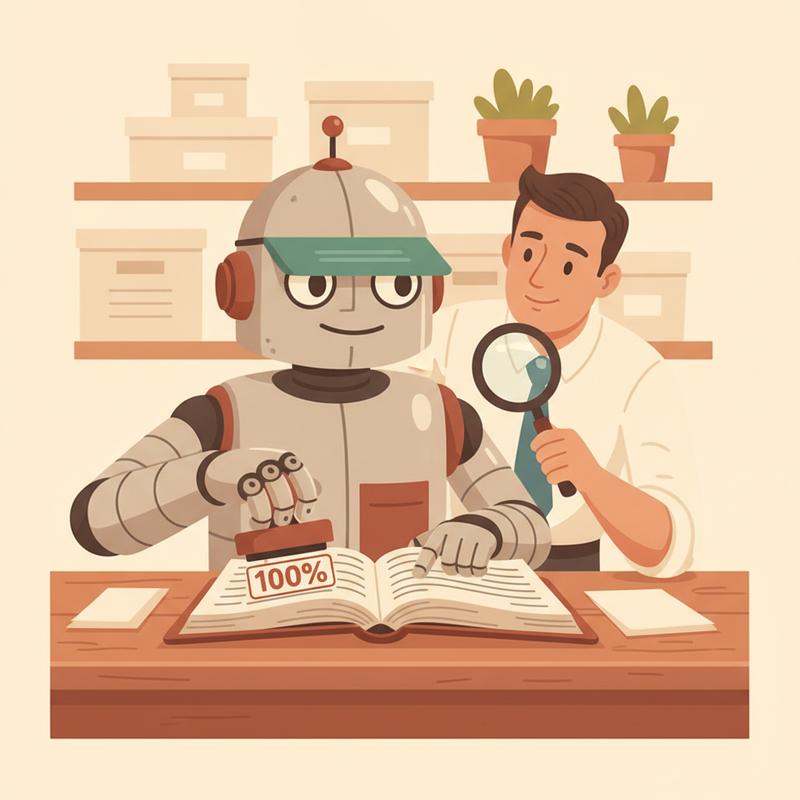
Its product is a set of AI agents called Clerks. A CPA firm assigns a Clerk to an audit the way it would assign a junior auditor. The Clerk reviews documents, runs tests and prepares workpapers. If a document is missing, it asks the client, waits, and picks the work back up when the file arrives.
Clark says more than 35 accounting firms use its tools, including CliftonLarsonAllen and Aprio.
Two details matter more than the funding:
- Human auditors still make the judgment calls and sign the final opinion.
- Clark offers firms a 100% accuracy guarantee.
And here's the line from founder and CEO Enes Witwit which made me stop and read the article twice:
"A promise of accuracy only means something when it has money behind it."
He didn't say the AI never makes mistakes. He said Clark puts money behind the promise. Those are two different claims, and the gap between them is where your next vendor contract lives.
No System Hits 100%
Let's get the engineering truth out of the way first.
No model, no human, no audit team hits 100%. Language models produce confident nonsense. People get tired at 4pm on a Friday. Spreadsheets carry broken formulas for years before anyone spots them.
So when a vendor says "100% accurate," you have two possible readings:
- The output never contains an error. No serious engineer believes this, and no serious founder should claim it.
- The vendor carries the cost when the output contains an error. This is a business decision, and a smart one.
Read Witwit's quote again. He's talking about reading number two. A guarantee is a risk transfer. It moves the cost of a mistake from your balance sheet to theirs.
I like it. I want more vendors to do it. But I want buyers to understand what they're buying.
Remember Deloitte
Clark's timing makes sense. Accounting has a recent, public example of what happens when nobody owns the error.
In 2025, Deloitte's Australian member firm agreed to partially refund the Australian government for a 237-page report, worth about US$290,000. The report contained references to academic papers which didn't exist and a fabricated quote from a federal court judgment.
A Sydney University researcher, Chris Rudge, spotted it when the report credited a law professor with a book outside her field. In his words to the Associated Press, he "instantaneously knew it was either hallucinated by AI or the world's best kept secret."
The revised version disclosed the use of Azure OpenAI. Deloitte said the fixes didn't change the report's findings.
Look at the sequence:
- A model generated the errors.
- A team of professionals shipped them.
- An outside reader caught them.
- The refund came after the press got involved.
Nobody in the building owned the check before the report went out the door. The tool wasn't the failure. The process around it was.
Your Name Is on the Chatbot
If you think the vendor's guarantee lets you off the hook, read Moffatt v. Air Canada.
In 2022, Jake Moffatt asked Air Canada's website chatbot about bereavement fares after his grandmother died. The bot told him to buy a full-price ticket and claim the bereavement discount within 90 days. The airline's own policy page said the opposite. Air Canada refused the refund.
Air Canada then argued, in front of a tribunal, its chatbot was a separate legal entity responsible for its own actions.
The British Columbia Civil Resolution Tribunal didn't buy it. In February 2024 it ruled the chatbot formed part of Air Canada's website, and Air Canada answered for everything on its website. The claim was worth CA$880. The precedent was worth a great deal more.
Here's the lesson for anyone buying AI tools: your customer doesn't care whose model it was. The audit opinion carries the CPA firm's name. The chatbot carries the airline's logo. The pull request carries your engineer's commit.
A vendor guarantee pays you back. It doesn't take your name off the work.
Read the Guarantee Like an Engineer
I haven't seen Clark's contract terms.
I'm not sure about this part: I couldn't find public detail on what Clark's guarantee covers, what it pays, or how a firm makes a claim. The TNW report and the founder's quote are all I managed to verify.
So I won't pretend to know how good it is. But I know the questions I'd ask before I signed, and they apply to any AI vendor waving a guarantee at you:
What counts as an error?
A wrong number in a workpaper? A missed test? A document the Clerk never asked for? The definition decides everything. A guarantee covering "calculation errors" and excluding "judgment" covers the easy part and leaves you the hard part.
Who finds it?
Most guarantees pay out when you prove the mistake. So you still need people who check the output. If your team stopped checking because the vendor promised 100%, nobody will spot the error until a regulator or a customer does.
What does it pay?
A refund of the subscription fee? The cost of rework? Your losses from a restated audit? Those are wildly different numbers. Ask for the cap in writing.
What happens to the reviewer?
Here's the one most buyers skip. Clark's own model keeps a human auditor signing the final opinion. Good. But if the AI does all the preparation, the auditor reviews work they never did. They need the skill to spot a wrong answer they didn't produce. Junior auditors build the skill by doing the grunt work... the exact work the Clerk now does.
Who trains your next senior reviewer?
Ownership Beats Accuracy
I've written before about how the audit trail is the product. Clark's guarantee pushes the same idea one step further. The thing you're paying for isn't a perfect answer. You're paying for a clear answer to "who owns this when it breaks?"
It's a leadership question, not a technology question. And most teams have no answer today.
Try it on your own shop. Pick one AI tool your team uses every day. Code assistant, meeting summariser, support bot, whatever. Then answer three questions:
- When it gets something wrong, who notices first?
- Who fixes it?
- Who tells the customer?
If the answer to all three is "we'd figure it out," you have the Deloitte setup. A tool, a team, and no owner.
If you name a person for each, you have something better than a 100% guarantee. You have a team where someone checks the work before it leaves the building.
What I'd Do This Week
Here's my advice, whether you're buying AI or building it:
- Buying? Ask every AI vendor what happens when their product is wrong. If they say "it won't be," walk away. If they show you a guarantee with money behind it, read the definition of "error" before you read the price.
- Building? Steal Clark's idea. Put a number on your confidence. If you won't stand behind your output with money, ask why you expect a customer to stand behind it with their reputation.
- Leading? Name an owner for every AI output which reaches a customer. One person. Not a committee, not "the team."
The vendors will keep getting better. The models will keep getting cheaper. None of it changes who signs the final page.
So whose name is on yours?