Sometime in early 2025, Apple's most senior executives packed into a conference room near Craig Federighi's software engineering wing. COO Jeff Williams called the meeting. Design chief Alan Dye was there. Vision Pro lead Mike Rockwell. Craig Federighi. AI chief John Giannandrea.
Tim Cook didn't attend. He didn't need to. Everyone already knew what they were there to discuss.
Apple Intelligence had failed.
Not failed in a "we missed a deadline" way. Failed in a "we showed the world features that didn't functionally exist" way. At WWDC 2024, Apple promised a transformed Siri... contextual awareness, cross-app actions, personal intelligence. The company's entry into the AI era.
When engineers tested it internally, reliability sat at 67%. And out in the real world, Siri answered factual questions correctly 67% of the time. Google Assistant: 89%. ChatGPT: 94%.
Apple had spent seven years and billions of dollars on this. They'd hired John Giannandrea away from Google... the man who had built Google's AI capabilities into something formidable. And the result was a feature set making Siri the butt of tech jokes.
So what went wrong?
Not what you think.

The Money Was There
Apple spent more on R&D in 2024 than the GDP of some small nations. They had talent. Giannandrea was considered one of the best AI leaders on the planet. They had hardware... the A-series chips are arguably the best consumer processors ever made. Privacy constraints played a role, yes. Apple has always worked within constraints.
No. The deeper problem was culture.
Not "culture" in the vague way executives talk about it in all-hands meetings. Actual, specific, structural culture choices making it impossible for Apple to build AI at speed.
What Secrecy Does to a Codebase
Apple's secrecy culture is legendary. No one outside your immediate team knows what you're building. Competitors definitely don't know. But... neither do the teams down the hall.
One former Apple engineer described the situation bluntly: "Due to the secrecy and compartmentalization, many efforts are duplicated."
Think about what that means for an AI system. Building good AI requires data flowing between teams. Model insights informing product decisions in near real-time. Engineers building on each other's work. The kind of cross-pollination Google, Meta, and OpenAI do constantly.
At Google, according to a former Apple engineer who'd worked at both places, teams were able to "ship a model update on Tuesday and see impact on Thursday." At Apple? The same cycle took months.
Months. In an industry where OpenAI and Anthropic were shipping meaningful improvements every few weeks.
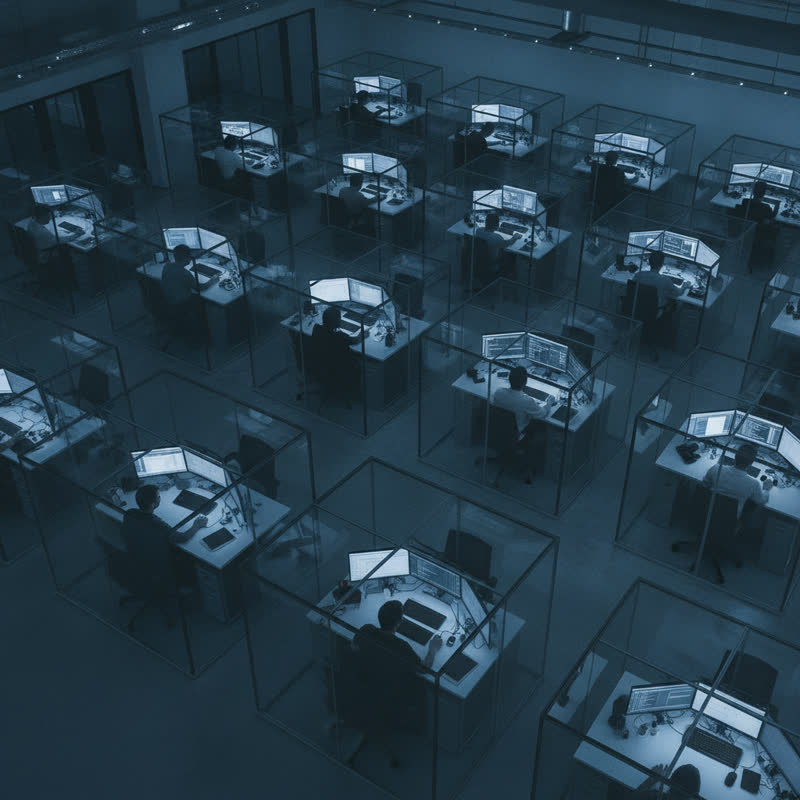
Speed races aren't won when your culture runs on secrecy. Information silos don't protect you from competitors. They protect you from yourself.
The Privacy Paradox
Apple made a strategic bet on on-device AI and privacy-first design. I admire the reasoning. User data should stay on-device. Training shouldn't require hoovering up everything your users do.
But a cultural commitment to privacy hardened into something else: a straitjacket.
Another former Apple engineer put it plainly: "Every option was either forbidden or severely constrained."
Privacy isn't the problem. Privacy as an unquestionable constraint enforced by culture... that's the problem. At some point, the question stopped being "how do we build AI respecting privacy?" and became "how do we avoid any decision raising a privacy concern?"
Those two questions lead to different products.
The Talent Drain Nobody Talks About
Between 2023 and 2025, at least 47 researchers left Apple's AI division. Eighteen went to OpenAI. Twelve to Google. Nine to Meta. Five to Anthropic.
That's not normal attrition. That's an indictment.
Researchers don't leave the most prestigious hardware company in the world for pay reasons alone. They leave when they feel their work doesn't matter. When decisions get made above them without input. When they watch competitors shipping things they pitched a year ago and got turned down on.
Apple's response to losing Giannandrea's credibility as AI chief? Move Siri to Mike Rockwell, the Vision Pro guy. A brilliant hardware leader... now tasked with fixing a software and data problem. The org chart change didn't change the culture.
Then Apple surrendered. They negotiated with Google to use Gemini and Google Cloud infrastructure to build Apple's own Foundation Models. The company spending decades building everything in-house went to the competitor it's been suing over search deals, hat in hand.
This Isn't Just About Apple

Here's why I'm writing this.
Every week I talk to leaders... and I see the same Apple story playing out at a smaller scale.
A CTO with a solid AI roadmap, paralyzed because three other teams need to sign off on anything touching customer data. A VP of Engineering whose best ideas die in committee because the culture rewards process adherence over outcomes. A startup founder who hired an expensive new tech lead and then surrounded them with constraints so thick they couldn't do the job they were hired for.
Apple is the most visible version of this pattern.
"Culture eats strategy for breakfast." Whether Peter Drucker said it or not (and it's disputed), the truth holds: the environment your strategy runs in determines whether it lives or dies. Apple had strategy. They had talent. They had a roadmap.
Culture ate the roadmap.
What Your Cultural Constraints Are Costing You
Before you write a roadmap this quarter, ask yourself three questions.
What decisions require more than two sign-offs? Every additional approval layer is a tax on speed. Some taxes are worth paying. Most aren't. At Apple, the culture of secrecy meant decisions made at the team level moved up and up and up. By the time something got approved, the world had moved on.
What are your teams not allowed to discuss with each other? Silos exist in every organization. Often they're built for good reasons... legal, competitive, security. But when teams working on adjacent problems don't know what each other are building, you get duplicated work at best and incompatible systems at worst. Apple's AI teams were building redundant capabilities for months because they weren't allowed to share.
What constraints do you treat as religious texts? Apple's privacy commitment is real and worth respecting. But it stopped being a principle and became a cultural ceiling. Your version might be "we never deprecate features," or "we don't ship without full QA sign-off," or "the data team owns all data decisions." These start as sensible rules. Over time, they become the bars of the cage.
The Hard Part
None of this is easy to fix. Apple's culture is Apple's culture because it built Apple. The same secrecy letting them build the iPhone without leaks... the same top-down decision-making keeping Jobs focused on outcomes... those aren't incidental to Apple's success.
But time changes the game. The AI era rewards sharing, iteration, and speed. Apple's culture was built for an era rewarding secrecy, perfection, and patience.
You don't need to blow up your culture. You do need to look at it honestly and ask: which parts of this are helping us ship? Which parts are slowing us down? Who has the standing to say "this constraint isn't worth its cost" without getting fired?
At Apple, apparently nobody did. Until they lost the AI race to everyone.
Don't wait for your failure meeting. Have the culture conversation now.