I ran a standup years ago where I finished with "Great job, team. Awesome sprint."
Four people looked back at me with the same flat expression. Nobody sat up. Nobody smiled. One person went back to their phone. I had said something nice and it landed like a dropped packet.
I told myself I was a good manager for saying it. I was wrong. I had said nothing at all.

Generic praise has no payload
Think about what "great job, team" contains as data. Who did what? Which decision mattered? What changed because of it? Nothing. Zero payload.
An engineer hears "great job" the same way you hear a log line with no timestamp, no severity, and no context. It fires. You ignore it. By the tenth one, you have filtered it out at the source.
It gets worse. Generic praise tells your team you were not watching.
If I say "awesome sprint" after a sprint where two people carried it and three coasted, everyone in the room knows I did not look. The praise is not neutral. It is evidence of my inattention.
The person who carried the sprint now knows their weekend went unseen. The person who coasted now knows coasting costs nothing. One sentence, two bad outcomes.

The numbers are worse than you think
Gallup and Workhuman tracked nearly 3,500 employees from 2022 to 2024. According to Gallup's recognition research, only 22% of employees say they get the right amount of recognition for their work. The number did not budge from 2022.
55% either receive no recognition at all, or receive the kind meeting none of the quality measures Gallup tested.
The retention side is where it bites. Employees receiving high quality recognition were 45% less likely to have moved companies two years later. Those whose recognition met at least four of Gallup's five pillars were 65% less likely to be hunting for another job. Hit four pillars and your people are nine times as likely to be engaged as the ones hitting zero.
Nine times. The intervention costs nothing but attention. Most leaders skip it and spend the budget on a quarterly awards ceremony instead.
My own survey work found 99.5% of respondents said they have had one or more types of bad boss. Almost none of those bad bosses thought of themselves as bad. They thought of themselves as busy. Saying "great job, team" is what busy looks like from the inside, and what absent looks like from the outside.
What you praise is what you get
Engineers optimize. It is what you hired them for. Point them at a measure and they will move it.
So look hard at what you have been praising.
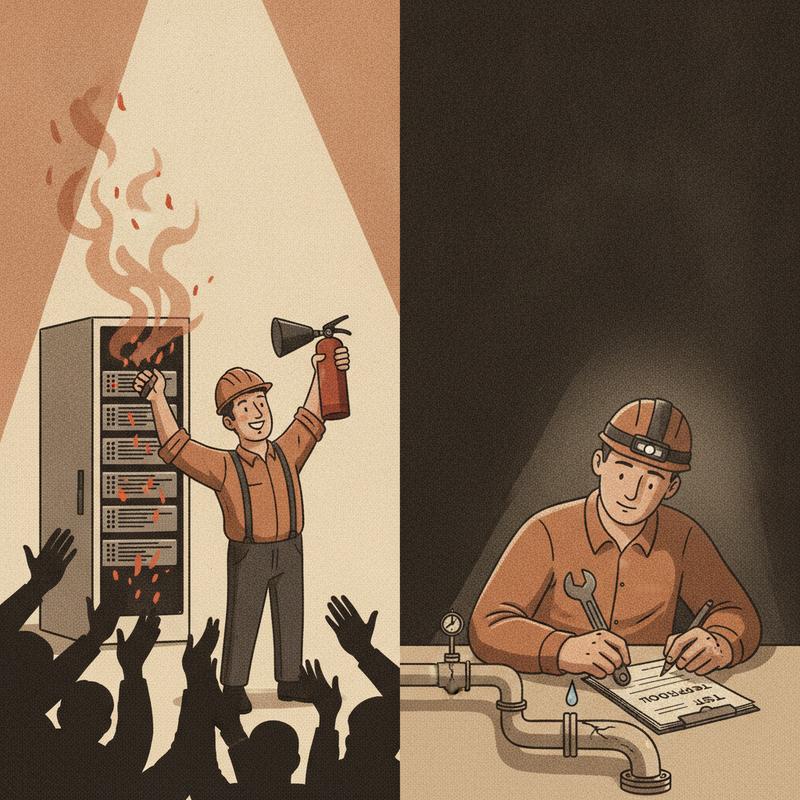
The engineer who stayed up until 3am firefighting production gets the shoutout in the all-hands. The engineer whose migration ran so cleanly nobody noticed gets silence... because there was nothing to notice.
Do this for two quarters and you have built a hero culture. Not because anyone chose one. Because your praise was the only reward signal in the system, and it pointed straight at the flames.
Goodhart's law says when a measure becomes a target, it stops being a good measure. Praise is a measure. Your team reads it as a target.
I have watched engineers quietly create the conditions for their own heroics. Not consciously. They deprioritize the boring hardening work, because hardening earns silence and the 3am save earns applause. You taught them the exchange rate.
Praise the work nobody saw
The best engineering work is invisible by design.
Deleted code. A migration with no downtime. A test catching the bug before the customer did. The architecture decision preventing a rewrite two years out. The engineer who talked the team out of a bad dependency.
None of it produces an incident. None of it produces a story. So none of it produces praise, unless you go looking for it.
Go looking. Read the pull requests. Sit in on the design reviews. Ask your senior people which quiet piece of work saved everyone the most pain this month, then go thank the person who did it.
What specific praise sounds like
Four parts. Name the person. Name the artifact. Name the consequence. Name what you want more of.
Weak: "Great job on the release."
Strong: "Priya, the feature flag you put on the payments path meant we rolled back in 90 seconds instead of an hour on Tuesday night. Nobody got paged. Do the same on the other risky paths."
The second one takes fifteen seconds longer to say. It carries a person, an artifact, a measured consequence, and a direction.
It is also unfakeable. You are unable to say it without having looked.
Here is the real reason leaders default to "great job, team". Generic praise is what you say when you do not know what your people did.
Say it in writing
Spoken praise evaporates. I wrote about this in The Praise You Say Out Loud Disappears. Say it in the room and it is gone by lunch.
Write it in Slack, in an email, in the review notes, and your engineer keeps it. I have met people still holding a printed email from a boss a decade ago.
Written praise survives the promotion committee too. Verbal praise never makes it into the packet.

Fair is not equal
One more trap.
If you praise five people identically after a sprint where the contributions differed wildly, you have not been fair. You have been lazy. You told your strongest contributor their extra effort carries no value, and you told your weakest they are doing fine.
Equal praise is the enemy of fair praise. Recognition tracks contribution or it means nothing.
If you have no idea how your people rate each other's contribution, a structured 360 feedback process is a decent place to start.
Your move
Open the last two weeks of messages you sent your team. Count how many contained a person's name, a specific artifact, and a consequence.
If the count is zero, your team has not heard from you. They have heard noise.
Pick one person today. Go look at what they shipped. Say the specific thing, in writing, where other people see it.
Then sit with the harder question... how long has your best engineer gone without hearing one word worth keeping?