Watch what happens in most tech companies when a people problem gets hard.
An engineer keeps missing deadlines and snapping at people in code reviews. The manager has known for three months. Nobody has said a word to the engineer. Then one Tuesday the manager books twenty minutes with the HR business partner, and the opening line goes something like this: "I need you to deal with this."
Now the other half. The team needs a lift after a rough release. Who gets the request for pizza, a quiz night and a Slack channel full of party emojis? HR again.
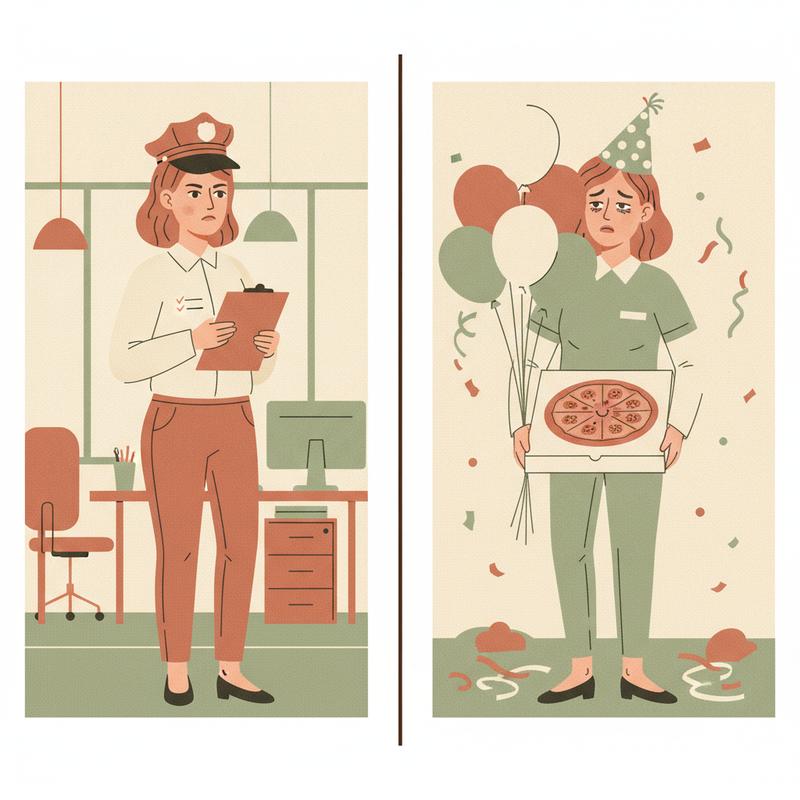
So HR gets two jobs. Bad cop, when you want someone else to deliver the bad news. Party planner, when you want someone else to deliver the good vibes. Both jobs share one feature. They let the leader skip the hard part.
I think both are wrong. HR isn't your bad cop. HR isn't your party planner. At its best, HR is your culture's conscience. And a conscience doesn't do the work for you.

A Chief Heart Officer Who Never Wanted to Do HR
Claude Silver is Chief Heart Officer at VaynerX. When she joined Debra and me on Corey-osity Unleashed (S1E9), she told us how she landed in the job.
She didn't come up through HR. She ran digital strategy at Publicis London, met Gary Vaynerchuk, and moved to New York in 2014 to run client partnerships at VaynerMedia. The average age in the building was 23. There was no HR team. So Gary handed her the hard conversations, exit conversations included, because she was the experienced adult in the room.
When they sat down to create the Chief Heart Officer role, she told him: "I've never done HR. I never wanted to do HR."
She took the job anyway. One of her first moves was renaming the department from HR to People and Experience. In her words, the role of HR is to be "a coach and a mentor and a teacher."
At the start of 2025, after a 2024 she called "a beast, a beast for everyone," she gave her own team a blunt instruction:
"I don't want you to be therapists."
She didn't want her people having the same conversation with an employee "two, three, four, five times." She wanted them coaching, connecting people with the right help, and looking after themselves along the way. She talked about empathy as riding alongside someone without taking their emotions on, which I wrote about in Empathy Isn't Walking in Their Shoes. It's Riding Shotgun. People join HR to be of service, she said. Not "to push paper around." And "not to be the bad cop."
Then she turned to the leaders:
"I want all of our leaders to be adults. I want all of our leaders to leave people better than they found them... I don't want to have to have the people and experience team go clean up the slop."
Clean up the slop. Four words, and they describe the job most companies hand their HR team.
Bad Cop, Party Planner, Janitor
Debra jumped in with her own memory of HR twenty years ago, when "it almost was the role of HR to pick up the pieces."
For plenty of companies, those twenty years never ended. Tech is the worst offender I know. We promote our strongest engineers into management, hand them a budget and a Jira board, and assume HR will take care of the human bits.
So HR ends up in one of three costumes.
The bad cop. You avoid the hard conversation until it turns into a crisis, then hand it to HR. The engineer hears the bad news from a near stranger holding a policy document. You keep your hands clean and lose the relationship anyway.
The party planner. You hand culture to whoever books the venue. Offsites, swag, wellness webinars. None of it touches how you run a one-on-one on a Wednesday afternoon.
The janitor. You manage badly, people get hurt, and HR mops up. Exit interviews, grievances, the quiet chat with someone who cried in a meeting room.
The Data Says Culture Lives With the Manager
Gallup estimates managers account for at least 70% of the variance in employee engagement across business units. Not the HR team. Not the perks budget. The person running the team.
My own research points the same way. 99.5% of the people we surveyed said they've had one or more types of bad boss. You won't fix a number like 99.5% with a better offsite.
Workers know where the problem sits. iHire's 2026 Toxic Workplace Trends Report, covered by HR Dive, surveyed 1,220 US workers. 79% blamed bad leadership for toxic workplaces. 72% pointed at poor communication from leadership.
Here's the part HR teams should lose sleep over. 39% of people who saw toxic behavior didn't report it. Of those, 45% didn't trust HR or leadership to help, and 36% feared retaliation. Among the people who did report, more than half said nothing changed.
The fear of retaliation has a basis. The Ethics & Compliance Initiative's 2023 Global Business Ethics Survey found 46% of employees who reported misconduct experienced retaliation, the same rate as in 2020.
Put those together. Employees blame leaders for the damage. Employees don't trust HR to fix it. And HR spends its days cleaning up after leaders instead of holding them to account. Nobody in the loop owns the problem.
This Argument Is Older Than Most of Your Engineers
In January 1998, Dave Ulrich opened his Harvard Business Review article, A New Mandate for Human Resources, with a blunt question: "Should we do away with HR?" HBR's summary of his answer: HR "should be defined not by what it does but by what it delivers."
Twenty-eight years on, most companies still define HR by what it does. Policies, payroll, parties, paperwork. Claude describes a different deliverable. Leaders who act like adults, and people who leave better than they arrived.
What a Conscience Does
A conscience doesn't do your job. It sits beside you and asks awkward questions. It speaks up before you do something you'll regret, and it nags you afterwards if you went ahead anyway.
Here's how I'd split the work.
Have the hard conversation yourself
If an engineer on your team is struggling, the news comes from you. Bring HR in early, as a coach. Ask them to help you plan the conversation, check your facts and spot where you're being unfair. If they sit in the room, they sit beside you. Not in your chair.

Stop outsourcing culture to the social calendar
Culture is how your one-on-ones go, how fast bad news reaches you, and what happens when someone pushes back in a design review. I wrote about the bad news part in Culture Isn't Perks. It's How Fast Bad News Reaches You. The pizza is fine. The pizza isn't the culture.
Give HR permission to tell you the truth
A conscience nobody listens to is decoration. Ask your HR partner what they're hearing about you. Ask which of your habits generate the most work for their team. Then don't punish the answer. If employees fear retaliation for reporting a colleague, picture how your HR partner feels about telling a senior leader the senior leader is the problem.
Close the reporting loop
More than half of the iHire respondents who reported toxic behavior saw nothing happen. Every report with no visible outcome teaches your team to stay quiet next time. Tell people what happened, within the limits of confidentiality. Protect anyone who spoke up, and make the protection visible.
Treat everyone as an adult, including yourself
Claude asked for leaders who act like adults. Debra made the flip side of the point on the same episode: "you hire adults and you treat them like children." The day before we recorded, she and I gave a Disrupt HR talk, and my line was about a boss trying to train me in something I learned in university "as if I had forgotten how to adult."
Adults own their hard conversations. Adults don't need a referee for every disagreement. Adults don't send someone else to deliver their bad news.
I'm not sure about this part: I looked for research comparing teams where managers deliver hard news themselves against teams where HR delivers it, and found nothing solid. My view here is opinion built on the data above, not a direct study.
The Question for Monday Morning
Look at the last three things you sent to HR. Were you asking for a coach? Or for a cop, a caterer or a cleaner?
If HR is cleaning up your slop, the slop is yours. Own it. Then ask HR to be what Claude built at VaynerX: the conscience in the room, the coach beside you, and the people who tell you the truth when nobody else will.
If you want help building leaders who own this work, Debra and I run leadership workshops at Step It Up HR.
What would your HR team say about you, if you gave them permission to be honest?