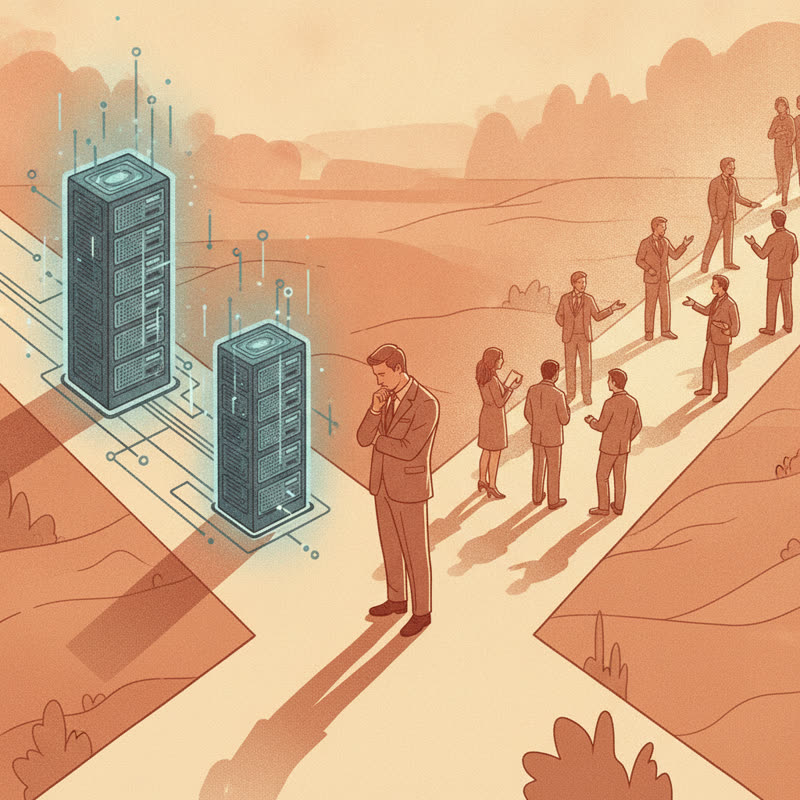
Here's a number worth sitting with: McKinsey's 2025 workplace AI report found 88% of organisations have adopted some form of AI. Only 6% are realising enterprise-wide value from it.
A BCG survey of 1,000 C-suite executives found roughly 1 in 4 is gaining real value. Before agentic AI became the buzzword, enterprise spending on generative AI hit $30-40 billion, and 95% of organisations saw little or no measurable return.
The models work. The APIs are reliable. The compute costs are falling.
The obstacle is leadership.
The Stat Nobody Is Talking About
The 2026 State of AI Agents report, based on surveys of over 500 technical leaders across industries, asked what's blocking organisations from scaling AI agents.
Integration challenges topped the list at 46%. Data quality came in at 42%. Change management? 39%.
Notice something? Two of the three top blockers are people and process problems, not technical ones. Integration challenges are as much about whether people will adopt new workflows as whether the APIs connect. Change management is entirely a leadership question.
Yet organisations put 90% of their AI transformation budgets into technology and 10% into the people who need to use it. McKinsey has the data: companies dedicate only 10% of transformation budgets to change management, despite cultural resistance being the primary success barrier.
Buy a Formula One car. Give your driver zero training. See what happens to your lap times.
Three Barriers. None of Them Technical.
Research from ZS identified three recurring human barriers to agentic AI adoption. None of them involve model performance.
Trust. Employees struggle with knowing when and how to trust autonomous systems. AI agents operate without direct human control. People who've spent careers building expertise don't hand decision-making to a system they don't fully understand. This is rational, not obstructive. Leaders need to earn trust through transparency and visible co-use, not assume it arrives with the software licence.
This is especially true when AI outputs are wrong and inexplicable. An agent making confident errors without explanation is a trust killer. Employees remember the bad outputs longer than the good ones. If you haven't set clear expectations about what the agent does well and where it fails, you've set your team up to distrust it permanently.
Oversight overload. Organisations add AI agents, then expect people to monitor them continuously on top of existing workloads. The result is fatigue, not efficiency. The entire point of an agent is to remove cognitive load. When deployment adds a new supervision burden instead, people start working around it. The agent sits dormant. Productivity stays flat. The CTO announces the pilot "didn't show results."
It showed results. You added work and called it efficiency.
Identity disruption. Nearly two-thirds of employees worry AI will erode their unique value at work. There's also a documented "social evaluation penalty": people using AI tools receive less professional credit from peers and managers. So employees face a specific situation where adopting the tool makes them look less competent to the people who influence their career.
Leadership created this dynamic by praising effort over outcomes and treating human-produced work as inherently more valuable. Leadership needs to dismantle it: by recognising AI-assisted work, by making clear which outcomes matter, by removing the social cost of adoption.
Buying better hardware solves none of these.
The Budget Problem
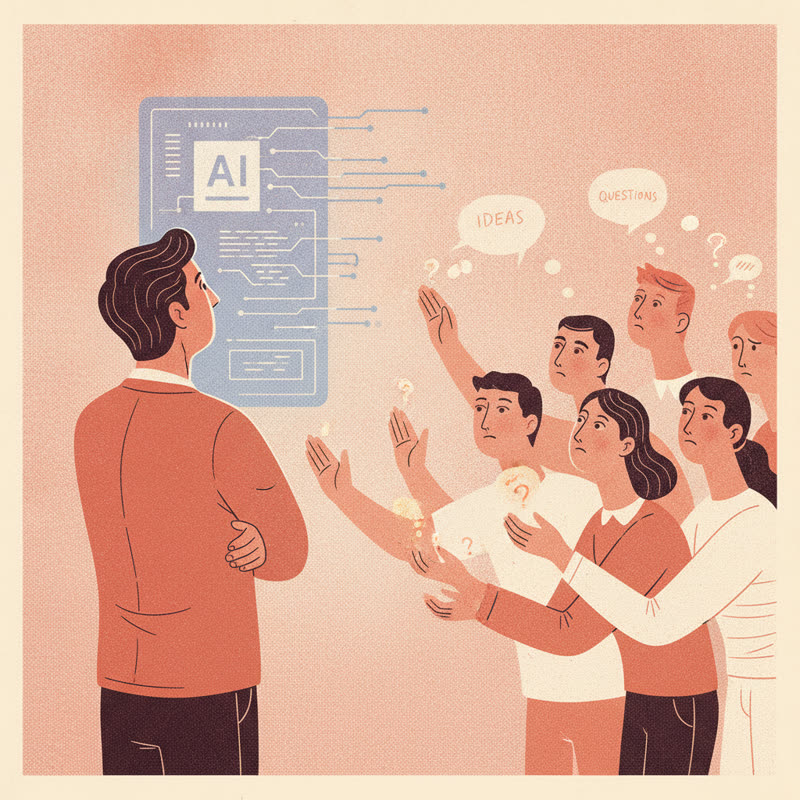
Look at how organisations allocate AI transformation spend.
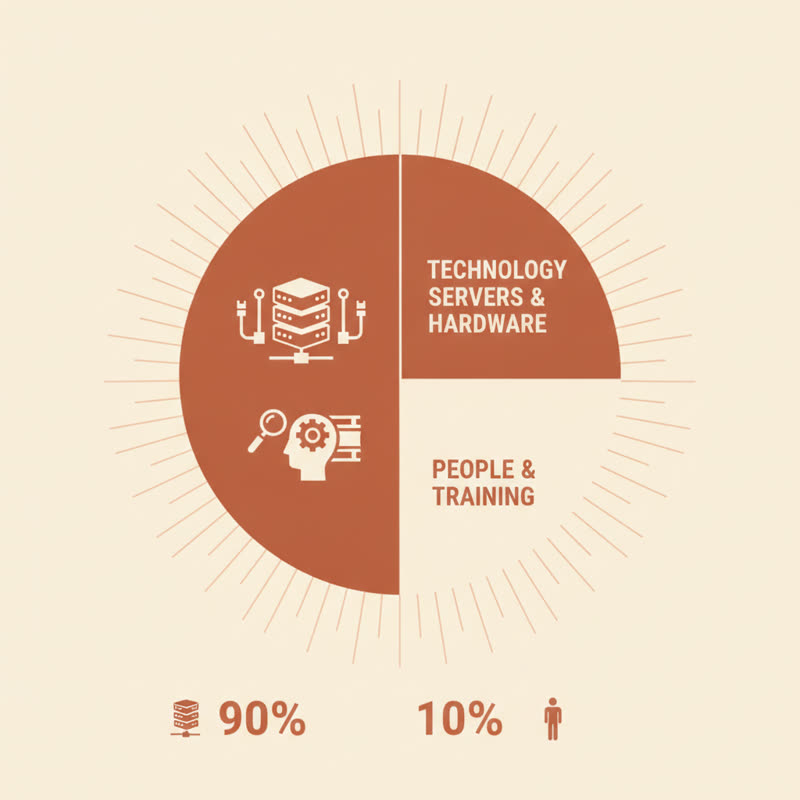
Ninety percent goes to technology. Ten percent goes to people.
Meanwhile, 89% of business leaders acknowledge their workforce needs stronger AI capabilities, but fewer than 6% have implemented meaningful training programmes. They know the problem. They're not solving it.
The gap between knowing and doing is a leadership gap.
Compare this to what works: companies pursuing genuine workflow redesign were 3.6 times more likely to report real financial returns. Yet only 21% of all companies using generative AI have redesigned any workflows. The remaining 80% bolt AI onto existing processes and wait for results.
AI sitting on top of broken processes produces faster broken processes. Redesigning the process is the work. Redesigning the process requires leadership.
What Good AI Leadership Looks Like
I've spent years at the intersection of technology and people systems. Leaders consistently treat these as separate problems. They're not. In the age of AI agents, this gap is expensive.
Be a visible adopter. If you're asking your team to trust AI tools, use them yourself. Openly. Share your prompts in team meetings. Show what didn't work and how you recovered. Model the learning curve. McKinsey calls this a "middle-out" approach: leaders visibly using AI creates permission for teams to do the same without social penalty.
Redesign the work, not only the toolset. Workflow redesign is uncomfortable. It means questioning processes people have used for years. It means acknowledging your current structure predates AI agents. Most leaders avoid this conversation. The organisations who have it see dramatically better returns.
Answer honest questions honestly. "Will this take my job?" deserves a real answer, not corporate messaging. If an AI agent will automate part of someone's role, say so. Then explain what shifts and what grows. Ambiguity breeds resistance. Clarity builds trust.
Give it time. Gartner predicts organisations will cancel 40% of agentic AI projects by end of 2027. Many of those cancellations won't happen because the technology failed. They'll happen because leaders ran out of patience with the human part of the change and pulled the budget before adoption had time to compound.
The Pattern I Keep Seeing
Here's what happens repeatedly. An organisation buys an AI agent platform. There's a launch event. A few enthusiastic adopters explore it. Three months later, usage has dropped, the vendor is asking for a renewal conversation, and the CTO is writing an internal post-mortem.
The technology worked fine. The change management didn't happen.
If your AI adoption strategy consists of buying a licence and sending an announcement email, you're not doing AI transformation. You're doing AI theatre. The organisation performs the ritual of adoption without doing any of the work adoption requires.
I built Step Up To BAT on a simple idea: leaders need clear, honest feedback about their own behaviour and its effect on their teams. The organisations succeeding with AI aren't the ones with the biggest tech budgets. They're the ones where leaders have the self-awareness to see their own role in adoption, and the discipline to change accordingly.
The models are ready. The infrastructure exists. The business cases are proven.
What's missing is a leader willing to do the slower, less visible, more human work: earning trust, redesigning work, treating adoption as a cultural shift rather than a software rollout.
The gap isn't technical. It never was.
What percentage of your AI budget goes to the humans who need to make it work? If you don't know the answer, you've already found your first problem.