Nobody walks into a compensation review and says, "let's break three good engineers this year." The breakage happens anyway. It happens because reward systems get designed by people who never model the behavior those systems produce.
I have run engineering teams for over 25 years. Every burnout case I watched up close had a paper trail leading back to a spreadsheet... a bonus formula, a promo rubric, an OKR with a number in it. The org chart did not cause the damage. The incentive design did.

The bonus goes to the firefighter
Picture two engineers.
The first ships a payment service. It runs for eighteen months without waking anyone up. No incidents. No war rooms. No 3am heroics. Her name never appears in an incident channel.
The second owns a service which falls over every few weeks. Each time, he stays up until 4am, pulls it back from the edge, and posts a thread about the recovery. Leadership sees grit. He gets the shout-out at the all-hands and a line in his review about "exceptional ownership under pressure."
Guess who gets promoted.
The first engineer prevented the outages. Prevention leaves no evidence. Firefighting leaves a highlight reel, and highlight reels are what promo committees read.
You never intended to pay for instability. You paid for it anyway.

Your promo packet has a body count
Look at what your promotion criteria reward at senior levels. In most companies it comes down to one word: impact. Impact gets proven with launches, migrations, incidents, and scope. Every one of those is a burst of intense work with a visible date attached.
Nothing in the rubric rewards a quiet quarter. Nothing rewards the person who deleted 40,000 lines of dead code, cut the alert volume in half, and gave six people their weekends back. Try writing it into a promo packet. The committee will ask for the business impact number, and you will have nothing to show but an absence... the incidents which never happened.
So your ambitious people learn the lesson fast. Volunteer for the launch. Take the migration. Own the noisy service, because noise generates stories. Then work the hours it takes to survive what you signed up for.
This is not a values problem. Your values slide is fine. The comp plan overrides the values slide every single time.
The numbers nobody puts in the comp deck
I do not want to build an argument on vibes, so here is the evidence.
Catchpoint's SRE Report 2025 surveyed over 300 practitioners. Median reported time spent on toil rose to 30%, up from 25% the year before, reversing five years of steady decline. Forty-six percent of respondents handled more than five incidents in the previous 30 days. Nearly 70% named on-call stress as a direct contributor to burnout.
LeadDev surveyed 617 engineering leaders in March 2025. Twenty-two percent scored at critical burnout levels. Another 24% came in as moderately burned out. Only 21% counted as healthy. Read it again... four in five engineering leaders sit somewhere on the burnout scale.
Then there is my own research behind the work I do with Step It Up HR: 99.5% of survey respondents said they have had one or more types of bad boss. Almost nobody escapes. And plenty of those bad bosses were decent people running a reward system they inherited and never questioned.
Four reward designs which manufacture burnout
1. The heroics bonus
Spot bonuses for weekend saves. Awards for incident response. Recognition tied to visible rescue work. Every one of these pays a premium for systems being broken. If the fastest route to a bonus runs through an outage, you have built an outage economy.
2. Velocity as a target
The moment story points become a target, they stop measuring anything. Teams inflate estimates or cut corners, and the ones who refuse to game it work longer to hit the number. You wanted a forecasting tool. You built an overtime lever.
3. Unlimited PTO with no floor
Unlimited PTO with no minimum is a budget trick wearing a benefits costume. With no floor, and no manager taking real time off, people take less leave, not more. Set a mandatory minimum, publish who has taken it, and hold managers accountable for their team's average.
4. On-call as a volunteer sport
Plenty of teams still run on-call with no extra pay, no time off in lieu, and no cap on incident load. The people with the least room to say no take the most shifts. Then you wonder why they quit in month fourteen.

What Google worked out twenty years ago
The Google SRE book sets hard numbers, and the numbers are the interesting part.
- "the maximum number of incidents per day is 2 per 12-hour on-call shift." Two. If a shift routinely runs hotter, the fix is engineering work, not a tougher rota.
- "We cap the amount of time SREs spend on purely operational work at 50%." At minimum, half an SRE's time goes to engineering projects.
- On-call gets paid. Google offers "time-off-in-lieu or straight cash compensation, capped at some proportion of overall salary." Capped, deliberately, so nobody farms pager duty for money.
Notice what each of those rules does. Each puts a ceiling on how much pain one person absorbs, and each converts pain into a signal management has to answer. A blown incident budget becomes a planning problem, not a personal failing.
Most companies do the opposite. Unlimited absorption, no ceiling, no signal, and a bonus for the person who absorbs the most.
Fifty hours is the wall
The counterargument shows up every time: crunch works, we shipped, look at the results.
Stanford economist John Pencavel studied munitions workers and found output per hour falls sharply past 50 hours a week. People working 70 hours produced no more than people working 56 (The Productivity of Working Hours, PDF).
Those extra 14 hours produced nothing. In software, where the work is judgment rather than repetition, the tail is worse than nothing. It goes negative. Tired people write the bugs which generate next month's incidents, which generate next month's heroics, which generate next month's bonus. The loop funds itself and eats your people.
Rewire it this quarter
Here is the concrete list. Most of it needs no budget increase.
- Audit last year's rewards. Pull every spot bonus, promotion, and top rating from the last twelve months. For each one, write down what the person did to earn it. Count how many required sustained overwork or an outage. If the count runs over a third, your system pays for crisis.
- Put prevention in the rubric. Add explicit promo criteria for reliability, deletion, alert reduction, and on-call load reduction. Ask for before-and-after numbers. Pages per week, mean time to recovery, incident count, lines removed.
- Pay for on-call, then cap it. Cash or time off in lieu, with a ceiling. Track incidents per shift. Over two, and the next sprint gets reliability work.
- Set a PTO floor. A published minimum, with managers going first.
- Kill the hero award. Replace it with a "boring quarter" award for the team with the fewest pages. Watch what happens to your on-call load in two quarters.
- Make burnout a leading metric. Pages per person per week, after-hours deploys, weekend commits, PTO taken. Review those in the same meeting as your delivery metrics.
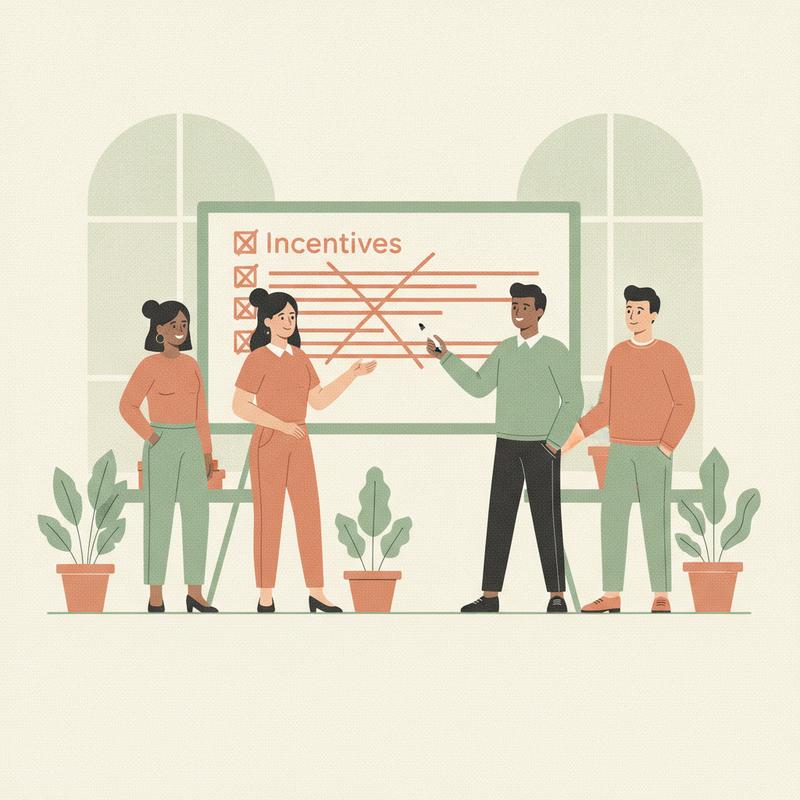
The part leaders skip
Reward design is the loudest thing you say to your team. Louder than your all-hands. Louder than your values.
Your people read the comp plan and the promo rubric like a map of what you want from them. If the map routes them through outages and weekends, they will walk the route... and the good ones will walk right out the door in month fourteen.
Go pull the list of everyone you rewarded last year. Read what each of them did to earn it.
Then ask yourself whether you would want your own kid working under those rules.