The annual engagement survey arrived in your inbox again.
Fifty questions. Four Likert scales. A progress bar lying about how long it takes. You fill it out, or at least try to. Most of your team fills it out, or claims to. By March, HR has the results. By April, someone presents a deck with colour-coded charts. Two months later, the deck is buried somewhere in a shared drive and nothing has changed.
By next January, the cycle starts again.

Meanwhile, global employee engagement dropped to 20%... the lowest level since 2020. No coincidence. Something is broken. And the annual survey is part of it.
The Survey Industry's Dirty Secret
The employee engagement survey is a billion-dollar business. Qualtrics, Glint, Workday Peakon, Culture Amp... the list goes on. Every one of them promises actionable insights. Every one of them has customers who run the survey, get the results, and then do almost nothing.
Gallup's 2026 State of the Global Workplace report puts global engagement at 20%. In the US, it dropped to 31% in 2024... the lowest in over a decade. Manager engagement fell nine points between 2022 and 2025 alone. The estimated cost? An eye-watering $10 trillion in lost productivity. Nine percent of global GDP.
The engagement survey industry has been growing for 25 years. Engagement is at its lowest point in a decade. You do the maths.
If the tool worked, we would not be here.
Three Reasons Surveys Fail (It Is Not the Format)
Most HR teams assume the problem is survey fatigue. Too many surveys. Too many questions. The solution must be shorter forms, or fewer of them.
Wrong.
A McKinsey review of more than 20 academic studies found the primary driver of survey fatigue is not the number of surveys sent. It is the perception the organisation will not act on the results.
The diagnosis changes entirely. The problem is not question count. It is the trust deficit.
Here are the three things killing your survey before anyone opens it.
Anonymity is theater.
Many employees believe HR identifies their survey responses, even when told otherwise. So they moderate. They write what feels safe, not what they think. You get a cleaned-up version of reality... not the real one.
The questions measure the wrong thing.
Work Institute's analysis, drawn from over 600,000 employee interviews conducted since 2000, found most surveys ask how employees feel rather than examining the workplace conditions creating or killing engagement. You measure the symptom. You get shallow data with no clear path to action. Worse, you benchmark yourself against external standards instead of addressing your own internal problems... and declare yourself fine.
Nothing changes, so people stop answering honestly.
Work Institute put it plainly: collecting feedback without follow-up is worse than not asking at all. You have confirmed what employees already suspected. When they learn feedback goes nowhere, they stop telling you anything useful. You end up with polished survey scores and a team counting down to their next job.
What Voice AI Changes
Startups are not waiting for HR to catch up.
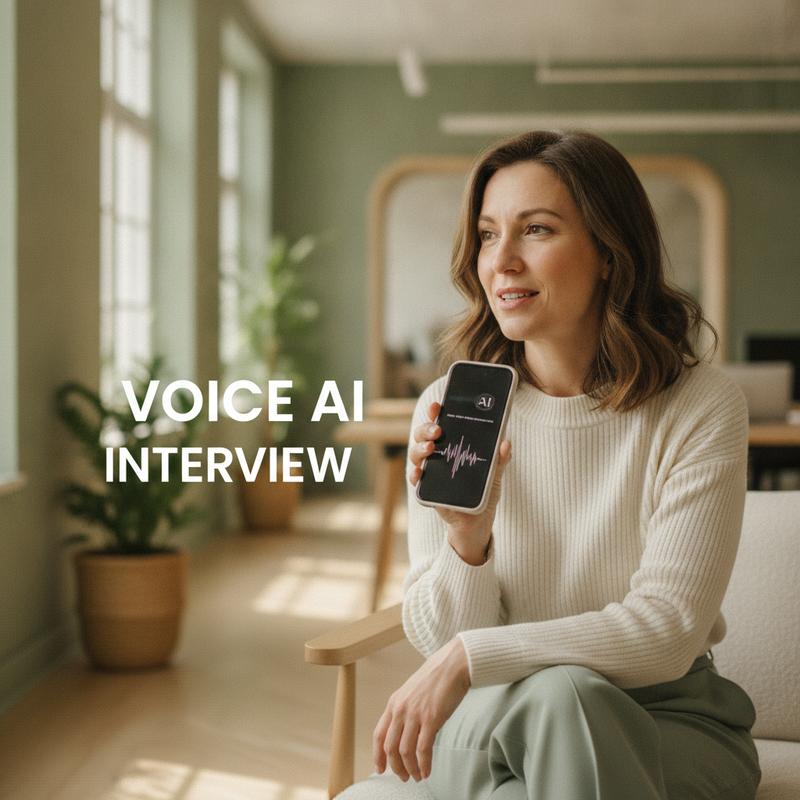
A new generation of tools... platforms like Talkscape and Talenteria... are replacing text surveys with voice-based conversations. Employees speak to an AI agent, naturally, in their own words. The AI transcribes the conversation, analyses tone and emotion, and surfaces the themes worth acting on.
The numbers from Talkscape's customer data are striking: one client reported cutting reporting time by 95%, moving straight from thousands of comments to actionable themes. Another saw staff turnover drop 15% after the voice approach revealed hidden issues text surveys had been masking for years.
The appeal is not hard to see. Speaking is more natural than typing. People say more. They say it differently. A sentence typed into a form is a considered, guarded response. A spoken answer captures hesitation, frustration, confidence, and doubt in ways no Likert scale ever will.
There is a psychological shift too. A voice conversation feels less like filling in a form under surveillance and more like talking. Employees describe problems in their own language rather than mapping feelings onto a 1-5 scale. The nuance comes through.
Continuous voice feedback solves the lag problem. By the time annual survey results land, the people who gave the feedback have moved on. Some of them have left. Real-time voice tools mean you hear about problems while you still have time to fix them... not twelve months after the fact.
The Thing No Technology Resolves
Here is where I need to be honest with you.
Voice AI is a better delivery mechanism. It is not a culture fix.

If your employees do not feel safe telling you the truth, they will not tell an AI the truth either. They will moderate their voice interview answers the same way they moderate text forms. The medium changes. The fear does not.
Psychological safety is not a product feature. It gets built through years of leaders responding to hard feedback without punishing the people who gave it. Through managers who thank people for problems raised, not silence them. Through cultures where "what aren't you getting from me?" is asked genuinely and often, not once a year in a corporate ritual everyone has stopped believing in.
At Step It Up HR, the 3 A's framework... Awareness, Acceptance, Action... exists because specific, meaningful, actionable feedback requires a foundation of trust. Voice AI helps. Anonymised pulse checks help. But they are multipliers on top of something built by hand, through hundreds of individual interactions where leaders prove they deserve honesty.
If your engagement scores are low, the problem is not the survey format. It is the gap between what you ask and what you do.
What To Do Instead
You do not need to wait for your organisation to adopt voice AI before fixing this. Start with the fundamentals.
Kill the annual cycle. Yearly surveys are a relic of a time before continuous data. Run quarterly pulse checks at minimum. Monthly if your team is under 50 people. The closer feedback sits to the moment it happened, the more useful it is.
Close the loop publicly. When you hear something from the team, say so explicitly. "We heard X is a problem. Here is what we are doing about it." Silence after feedback teaches people feedback is pointless. One public response to a hard piece of feedback does more for your credibility than ten all-hands meetings.
Consider voice tools. Not as a replacement for culture work, but as a better collection mechanism. If your team does not believe your surveys are anonymous, a voice conversation with an AI agent often feels less surveilled, not more. The bar for entry is low... some platforms start at a few hundred dollars a month for small teams.
Ask better questions. Instead of "how engaged do you feel?", ask "what is the one thing getting in the way of your best work?" Or "what do you wish your manager understood about your role?" Conditions. Specifics. Problems you have space to act on. Questions whose answers tell you what to change, not how people feel about the current state.
Respond visibly and soon. McKinsey and Work Institute point to the same root cause: people stop filling in surveys because they stop believing anyone reads them. The only fix is demonstrating, repeatedly and publicly, you hear and you act. Even partial responses help... "we heard this, we're working on it, here's where we are" beats silence every time.
The Real Question
Your last annual survey arrived at some point in the past twelve months. You got the results. What did you do with them?
If you are honest about the answer, you might also be honest about the question: is the tool broken, or is the commitment?
Voice AI will change how feedback gets collected over the next five years. Startups are already there. The technology removes friction, captures emotion, cuts reporting time from weeks to hours. Worth paying attention to.
But the most important piece of this equation is not the platform. It is the culture deciding what to do with what it hears.
The annual survey is not lying to you on purpose. It is giving you exactly what you built it to give you: a comfortable way to say you listened without committing to anything.
Time to fix it.