Sally Gibson is Managing Director of Dawleys, a contact center and fulfillment business in Ross-on-Wye, Herefordshire. When she joined Debra and me on Corey-osity Unleashed, she told a story about her employee Net Promoter Score which every engineering leader should hear.
Dawleys asked staff the standard eNPS question. "How likely are you to recommend this company as a place to work?" Zero to ten.
Plenty of her people read it as a recruiting question. Would you go out on the street and sign up new hires for us? Of course they scored it low. Nobody wants to stand outside Tesco with a clipboard.
Sally had to train her team on what the question meant before the numbers meant anything. And once she did, she found something else. The nominations on her WOW Board, a peer recognition wall, told her more about engagement than the survey score ever did.
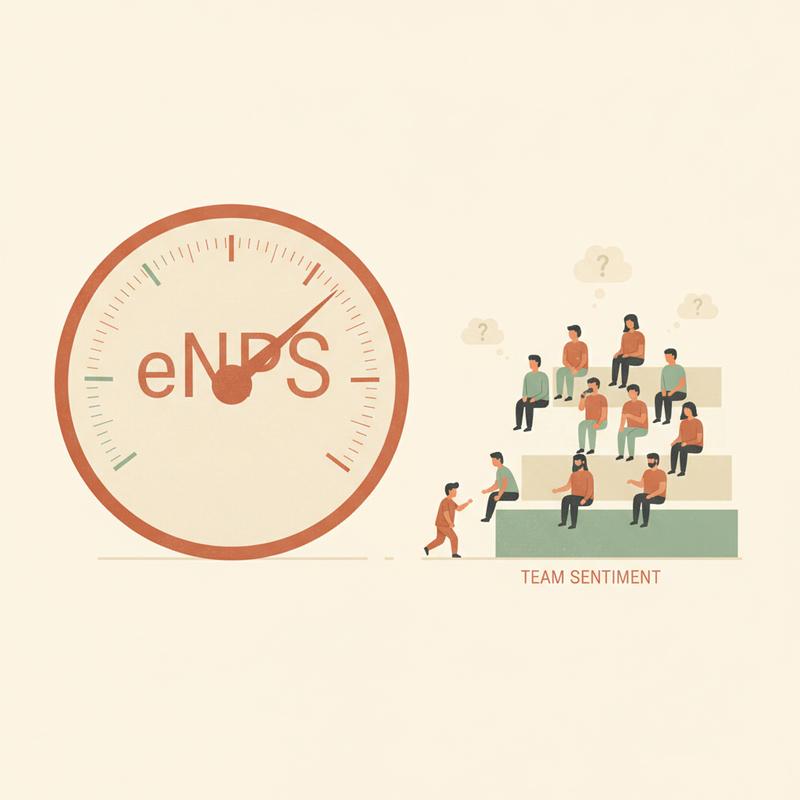
I laughed when she told it. Then I stopped laughing, because I've watched leadership teams treat eNPS like a production metric. It isn't one. It's a single, ambiguous input with huge error bars, and most of us ship decisions off it anyway.

Where the one number came from
In December 2003, Fred Reichheld published The One Number You Need to Grow in Harvard Business Review. The pitch was simple. Ask customers one question about recommending you. Count the 9s and 10s as promoters. Count 0 through 6 as detractors. Ignore the 7s and 8s. Subtract detractors from promoters and you have your score.
Executives loved it. One number. Easy to explain at a board meeting. Easy to put in a bonus plan. HR borrowed the idea, swapped "customer" for "employee," and eNPS was born.
Here's the problem. The science behind the original claim did not hold up well.
In 2007, Keiningham and colleagues published A Longitudinal Examination of Net Promoter and Firm Revenue Growth in the Journal of Marketing. They used longitudinal data from 21 firms and more than 15,500 interviews from the Norwegian Customer Satisfaction Barometer. Their finding: the research "fails to replicate his assertions regarding the 'clear superiority' of Net Promoter compared with other measures."
They went further. Using the industries Reichheld himself picked as exemplars, a plain customer satisfaction index beat Net Promoter as a predictor of growth in two of the three cases they were able to test. Their conclusion was blunt. Managers adopted the metric believing "solid science underpins the findings," and "such presumptions are erroneous."
Those studies looked at customers, not staff. I'm not sure about this part: I found no peer-reviewed study testing whether eNPS predicts retention or performance better than other engagement measures. If one exists, I'd love to read it. Until then, eNPS rests on a customer metric whose own foundation is shaky.
Even the inventor says stop chasing the score
You don't need to take a critic's word for it. Reichheld said it himself.
In a 2019 LinkedIn response, he wrote: "Making the score the objective simply leads to gaming and manipulation."
Two years later, in Net Promoter 3.0 for HBR, Reichheld and his Bain co-authors listed the abuses they'd seen. Pleading ("I'll lose my job if you don't rate me a 10"). Bribery. Skipping surveys for unhappy customers. They called out companies "linking Net Promoter Scores to bonuses for frontline employees, which made them care more about their scores than about learning to better serve customers."
Now picture the same thing inside your company. A VP has an eNPS target in their objectives. Team leads hear about it. Survey week arrives with a pizza lunch and a gentle reminder about "how much we've invested in culture this year." The number goes up. Nothing else changes.
Goodhart's law, in a hoodie.
The question is ambiguous, and ambiguity is noise
Sally's team did not misread the question because they're careless. They misread it because survey questions get misread all the time.
Survey researchers have known this for decades. William Foddy's book Constructing Questions for Interviews and Questionnaires describes a 1953 study by Nuckols. He gave nine poll questions to 48 respondents and asked them to restate each one in their own words. One in six interpretations came back partly or completely wrong.
One in six. On questions written by professional pollsters.
Now look at the eNPS question through your engineers' eyes. "Recommend working here" to whom? A friend who's a senior backend developer? A friend fresh out of a bootcamp? Someone who wants remote work? Someone who wants a promotion in the next year? Each of those people gets a different honest answer from the same employee.
So when the score drops, you don't know which question your team answered. You only know a number moved.
Your team is too small for this metric
This is the part which bothers me most as an engineer. eNPS throws away most of its own data, then gets read like a precise figure.
Take a team of ten. Four people score 9 or 10. Three score 7 or 8. Three score 6 or below. Your eNPS is 40 minus 30, which gives you +10.
Next quarter, one person slides from an 8 to a 6. Nothing else moves. Your eNPS is now 0. A ten-point drop, from one human being having a bad month.
It gets worse. Someone who goes from a 1 to a 6 moves the score by zero. Someone who goes from a 6 to a 7 moves it by ten points. The scale treats a massive recovery as nothing and a tiny nudge as a headline.
I ran the standard error for Net Promoter on the ten-person example. A rough 95% confidence interval comes out at about 50 points either side of +10. Your "+10" is a range from around -40 to +60. You would never ship code on test results this noisy. Why ship a reorg, a manager review, or a culture program on them?
What Sally's WOW Board got right
Sally's fix interests me more than her problem.
The WOW Board is a wall where colleagues nominate each other for doing something great. It isn't anonymous. It isn't quarterly. It doesn't ask anyone to predict a hypothetical recommendation to a hypothetical friend.
It records behavior. Who noticed whom. Which teams thank each other. Who never gets mentioned. Which managers' people show up on the wall every week, and which managers' people never do.
Those are signals with names and context attached. You follow up on them. You ask "why hasn't the platform team appeared on the board since March?" and get a real conversation instead of a shrug at a percentage.
I'd trust a quiet WOW Board over a falling eNPS any day. The board tells you where to look. The score only tells you to worry.

How to fix your eNPS habit
I'm not telling you to bin the survey. I'm telling you to stop treating it as the dashboard.
Test the question before you send it
Run Nuckols' trick on five people. Ask them to tell you, in their own words, what the eNPS question means. If you hear "recruiting," "referral bonus," or "depends who's asking," rewrite it. Sally fixed her data by fixing comprehension first.
Report raw distributions, not one number
Show the count of every score from 0 to 10. A shift from 8s to 6s tells a different story than a shift from 9s to 7s, and the single eNPS hides both.
Never put eNPS in anyone's objectives
Reichheld's own warning is enough. A target turns a listening tool into a performance to manage. Your people will notice, and the honest answers stop.
Ask the follow-up every time
"What's the main reason for your score?" The free text is where the value lives. Read every answer. Then go and talk to people.
Pair it with behavior you see
Peer recognition, internal transfer requests, regretted attrition, who volunteers for on-call. These things happen whether or not anyone fills in a form, and they come with context you act on.
Treat small-team scores as ranges
For any team under twenty, report the range, not the point. If your number moved less than the width of the range, nothing moved.
The real question
eNPS asks your people to forecast a conversation with a stranger. Sally's team showed how easily even the meaning of the question gets lost. The research shows the metric never earned its reputation. The math shows small teams won't produce a stable score.
You already have better data walking around your office every day. When did you last look at who's thanking whom, instead of what the number did?