A pull request lands on a Thursday afternoon. No tests. The description says "quick fix." You see it go through. You have a release to worry about, so you say nothing.
Nobody on your team heard you announce a new standard. You announced one anyway.
The next week, two more PRs go in without tests. Then a hotfix skips review entirely. Nobody decided to lower the bar. You lowered it on Thursday, with your mouth shut.
Dan Greene from Radical Candor put this better than I ever have when he joined us on Corey-osity Unleashed (S2E4): silence teaches more than feedback ever will. People infer meaning when leaders say nothing.
I keep coming back to his line, because most managers I know treat silence as the safe option. It isn't. Silence is a message with no caption, and your team writes the caption for you.
Your Team Fills the Gap. They Don't Fill It Kindly.
When you say nothing, people don't hear nothing. They guess. And when people guess about their boss, they rarely guess generously.
Gallup tested this. They asked a random sample of 1,003 US employees whether their supervisor focused on their strengths, their weaknesses, or neither. A quarter of them landed in the "neither" bucket. Gallup called them "ignored."
Here's the part I didn't expect. Employees whose manager focused on their weaknesses had a 22% chance of being actively disengaged. Not great. But employees whose manager ignored them were about twice as likely to be actively disengaged as the weakness group. People who heard mostly criticism did better than people who heard nothing at all.
Gallup's heading for this finding says it all: "No news is not good news." Their conclusion was blunt. People would rather hear criticism than hear nothing.
Now think about an engineer whose design doc gets no reply for a week. Did you read it? Did you hate it? Is the project dead? Am I on the way out? Every one of those stories is worse than the truth. And you wrote the prompt for every one of them.

The Standard You Walk Past
In 2013, Lieutenant General David Morrison, then Chief of the Australian Army, recorded a video message about a scandal involving degrading emails from Army accounts. One line from his message took on a life of its own: "the standard you walk past is the standard you accept." Morrison later credited the phrase to General David Hurley, but it stuck to Morrison because he said it on camera and meant it.
As a former soldier, I know how this works from the inside. Nobody in uniform reads the regulations to learn the standard. You watch what the sergeant lets slide.
Software teams walk past things all day:
- The flaky test everyone re-runs until it goes green.
- The alert nobody acknowledges because "it always fires."
- The senior engineer who talks over juniors in design reviews.
- The "temporary" workaround from two years ago, still running in production.
Each time you see one and keep walking, you aren't staying neutral. You're voting. Your team counts the votes.

Broken Windows in Your Codebase
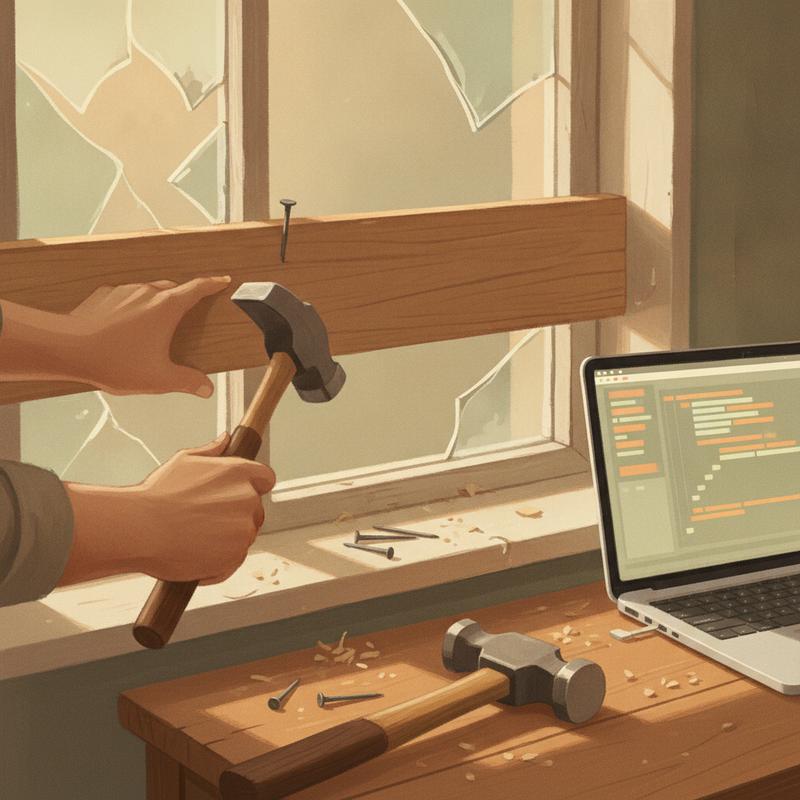
Andy Hunt and Dave Thomas made the same point about code in The Pragmatic Programmer. Their section on software entropy borrows the broken windows idea from Wilson and Kelling's 1982 Atlantic article: leave one window broken, and the building tells everyone nobody cares. More windows break.
The policing version of broken windows has drawn plenty of criticism over the years, and I won't defend it here. The code version holds up better, because the "neighborhood" is your repo and the "disorder" is a shortcut in plain view of the whole team.
Their Tip 4 reads "Don't Live with Broken Windows." Fix bad designs, wrong decisions and poor code as soon as you find them. If you don't have time to fix one properly, board it up. Comment out the offending code. Show a "Not Implemented" message. Do something to show you're on top of it. In their words, "neglect accelerates the rot faster than any other factor."
Here's what leaders miss. The broken window isn't the code. The broken window is you, walking past it. A junior engineer doesn't know whether the flaky test matters. They watch you to find out.
How Wrong Becomes Normal
Sociologist Diane Vaughan studied the Challenger launch decision and gave the slow version of this a name: normalization of deviance. An unsafe practice becomes normal because it hasn't caused a catastrophe yet. Vaughan describes a long incubation period full of early warning signs people misread, ignored or missed.
You've seen the engineering version. Your error rate creeps up two points. Nobody says anything. Next quarter, the new number is the baseline, and nobody remembers it used to be lower.
Nobody votes for deviance out loud. Silence passes it without a vote.
Silence Teaches the Good Stuff Too
This cuts both ways. In the same Gallup study, employees whose manager focused on their strengths had a 1 in 100 chance of being actively disengaged.
So what happens when you never mention the engineer who wrote the runbook, fixed the flaky test, or walked the new hire through their first on-call shift? You've taught the team those things don't count. They'll stop doing them. Not out of spite. They read your silence and acted on it.
I wrote about the flip side of this in Equal Praise Isn't Fair Praise. Generic thanks teaches as little as silence does.
In my own research, 99.5% of survey respondents said they'd had one or more types of bad boss. The silent boss is the easiest one to become without noticing. Nobody plans it. You get busy, you skip the comment, and the habit hardens.
Make Your Silence Mean Something
You won't comment on everything. You shouldn't. So decide what your silence means, and tell people.
1. Name the standard on the day you see it slip
Not in the retro. Not at review time. "This went in without tests. Our bar is tests on anything touching payments. Please add them tomorrow." Thirty seconds. No drama. The standard stays where you put it.
2. Board it up when you won't fix it today
Take the Hunt and Thomas advice. If the flaky test won't get fixed this sprint, file the ticket, tag it, and say out loud you've seen it. "I know about this. Here's the ticket." Those six words tell the team the window matters.
3. Publish your silence rules
Tell your team what no response from you means. "If I don't comment on a PR, I didn't review it. Silence isn't approval." "If I haven't replied to your doc in two days, chase me. I'm buried, not unhappy." Now your silence carries the meaning you chose, not the one their anxiety chose.
4. Say the good stuff out loud, and be specific
"Thanks, team" teaches nothing. "Your runbook got us through last night's incident in fifteen minutes instead of an hour" teaches everyone what good looks like. Public, specific praise sets the norm faster than any process document.
5. Audit your walk-pasts every Friday
Five minutes. What did you see this week and say nothing about? Pick one. Raise it on Monday.
What Is Your Silence Saying?
Every leader gives feedback all day. Some of it happens in one-to-ones. Most of it happens in the gaps: the PRs you let through, the alerts you shrug at, the wins you never mention. Your team grades all of it.
So here's your question for this week. If your team wrote down what your silence meant over the last month, would you agree with what they wrote?