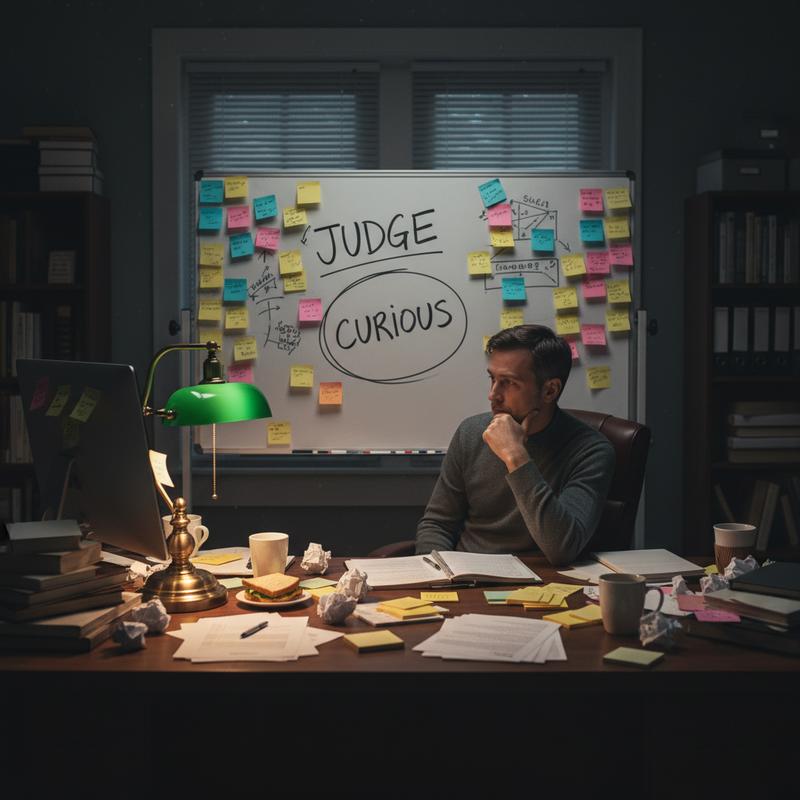
The Dart Scene I Keep Coming Back To
If you've watched Ted Lasso, you know the scene. Season 1, Episode 8. Rupert... Rebecca's smug ex-husband... challenges Ted to a game of darts. He mocks Ted the entire time, treating him like a bumbling American who wandered into English football by accident.
Ted misses his first throw. Badly. Rupert smirks.
Then Ted starts talking. He quotes "Walt Whitman"... who, as it turns out, never wrote those words. The quote is misattributed. Nobody knows who first said it. The Snopes piece on this is worth a read, if you're curious.
"Be curious, not judgemental," Ted says.
Then he wins the game. Decisively. Because Ted had been watching Rupert's technique the whole time. While Rupert was busy judging, Ted was busy learning.
I've returned to this scene more times than I'd care to admit.
The Default Mode
Your brain has a default mode. It isn't curiosity.
Under pressure, your brain defaults to threat assessment. It takes in new information and asks: is this safe or dangerous? Is this person with me or against me? Does this situation confirm what I already believe, or does it challenge me?
Judgment is fast. Efficient. It's your brain doing what brains evolved to do.
The problem is most situations at work... and in life... aren't life-or-death threats. They're complicated. Messy. Full of context you don't have yet.
When you judge first, you close off the information you needed to understand the situation properly.
As the team at BeHumanize put it in their piece From Judgment to Curiosity: "Most workplace conflict does not start with malice. It starts with interpretation." Your brain builds a story. The story feels like truth. Then you act on the story, not the facts.
My Own Rupert Moment
I'm not proud of this. But I've been Rupert more than once.
Early in my career, I managed a developer who was consistently late to meetings, gave short answers during updates, and never seemed engaged in standups. I'd made up my mind: he was coasting. Didn't care. Showing up for the paycheck and nothing else.
So I started managing him differently. Less trust, more oversight. I stopped including him in decisions. I told myself I was being "professional" about it. But the signal I was sending was clear enough.
Months later, during a one-on-one I almost cancelled, he told me his daughter had been seriously ill for most of the year. He'd been commuting to a specialist appointment every Tuesday... the day he was always late. He was exhausted and scared, and still showing up every single day.
He wasn't coasting. He was surviving.
I'd been judging him from a position of complete ignorance. And in doing so, I made his already hard year harder.
What Curiosity Looks Like in Practice
People talk about curiosity like it's a personality trait. Either you're wired for it or you're not. I don't buy this framing.
Curiosity, in the sense I'm describing, is a choice. A deliberate one. It's the choice to pause before you interpret. To ask before you conclude.
Here's what it looks like in practice:
Instead of: "He's always pushing back in meetings. He's a blocker." Try: "He pushes back a lot. What is he seeing?"
Instead of: "She's been quiet this week. She must be checked out." Try: "She's been quiet. I'll check in and ask."
Instead of: "This team doesn't care about quality." Try: "What would make it easy for this team to care about quality?"
The questions feel small. The shift in outcome is enormous.
As Tom Cutler writes at the Cutlefish Substack, the most capable leaders approach situations with "curiosity and a light touch... resisting the impulse to judge and act, while creating space to explore the thoughts and feelings." Not softness. Discipline.

Why This Is Harder Than It Sounds
Choosing curiosity over judgment is a cognitive effort. Your brain wants resolution. It wants a clean story, a label to file away. Staying curious means keeping things open longer than feels comfortable.
There's also a status element to it. Asking genuine questions... the kind where you genuinely don't know the answer... makes you feel exposed. It signals you don't have everything figured out. In many workplace cultures, this feels risky.
But here's what I've noticed: leaders who ask the best questions get the best information. Leaders who rush to judgment get less information over time, as people learn not to bring them anything complicated or uncertain.
You train your team on what's safe to bring you.
The Pause Is the Practice
The BeHumanize piece has a line I keep returning to: "Culture is built in the pause."
Not in the big speeches. Not in the vision statements or the town halls. In the moment between something happening and your response to it. Your real values live there.
Do you ask or do you tell? Do you get curious or do you get certain?
The pause is a practice. You build it the same way you build any skill: intentionally, repeatedly, with full awareness you'll fail at it regularly.
I fail at it regularly. I still walk into conversations having already made up my mind sometimes. I still catch myself reading tone into an email. The difference now is I recognise the pattern. And recognising the pattern gives me a chance to interrupt it.

For Leaders, This Is Not Optional
If you lead people... any people at all... your default setting gets amplified. Your team watches how you respond to uncertainty. They watch what happens when someone brings you a problem you didn't expect. They're learning, in real time, whether this organisation rewards curiosity or punishes it.
Research on psychological safety shows teams perform better when members feel safe to speak up, to ask questions, to admit they don't know something. The leader sets the tone for all of it.
If you judge first, your team will stop bringing you things worth judging. They'll pre-filter. Pre-spin. They'll work out what you want to hear and give you the sanitised version.
You won't notice it happening. The information will quietly stop flowing.
It Comes Back to Ted
The thing about the dart scene isn't the win. It's the setup.
Rupert spent the whole evening being certain. Certain he understood Ted. Certain of the outcome. His certainty looked like confidence. Like strength.
But Ted was learning the whole time. Watching, listening, taking in what was in front of him without deciding what it meant.
Rupert was judging. Ted was curious.
Whoever originally wrote those words... they were describing something worth practicing. Something separating people who keep learning from people who stop. People who build trust from people who erode it. People who lead well from people who lead badly.
Be curious, not judgemental.
Easier said. Worth the attempt.
What's your default setting, and when did it last cost you something?