Garry Ridge said something to me I have not been able to shake.
"Even the Queen sits down to pee."
He ran WD-40 Company for more than twenty years. I had him on my podcast. He is one of the few chief executives I have met who describes the job as service instead of status. The line is funny. It is also the shortest leadership lesson I know.
A title changes nothing about your biology. It changes nothing about your judgement, your blind spots, or your need for other people to tell you the truth. The chair is a chair. The crown is borrowed. Everybody in the building already knows this except, sometimes, the person wearing it.

I Learned This Wearing Boots
I served in the US Army. Rank is the entire architecture there. You salute the rank, not the man. Everyone gets told this on day one, and most people nod and forget it by the second week.
The good officers never forgot it. They understood the salute belonged to the position, and the position belonged to the mission, and the mission belonged to everybody. They ate last. They asked the sergeant what he thought and then shut up while he answered.
The bad ones took the salute personally. You watched it happen in slow motion. First they stopped asking questions. Then they stopped hearing answers. Then they started referring to the people under them as a resource, and by then it was over. Nobody would tell them anything true, and they interpreted the silence as agreement.
Same species. Same uniform. One difference: whether they believed the deference was about them.

Power Does Something To Your Head
I used to think this was a character issue. Some people are humble, some are not, bad luck for the rest of us. The research says otherwise, and it is worse news than a character issue.
Dacher Keltner at Berkeley has spent decades on this. His work found people given power in experiments lean harder on stereotypes and pay less attention to what makes other people individuals. They judge other people's attitudes, interests, and needs less accurately. In his summary of the research, Keltner puts it bluntly: people with power start behaving like patients with damage to the brain's orbitofrontal lobes, the region tied to empathy and socially appropriate behaviour.
Read the last sentence again. The promotion did to your empathy roughly what a head injury would.
Keltner calls it the power paradox. The skills you needed to earn the promotion, reading a room, feeling what other people feel, taking someone else's perspective, are the same skills the promotion quietly erodes. You get the job by being good with people, and the job makes you worse with people.
Nobody hands you a warning about this on your first day as a manager. They hand you a headcount budget.
The Number Nobody Wants Printed
My own research turned up a figure I have stopped apologising for. 99.5% of survey respondents said they had experienced one or more types of bad boss.
Not 60%. Not "a worrying number." Effectively everyone.
Set it next to engagement data. Gallup's latest finding, which we wrote about over at Step It Up HR, puts employee engagement at 21%. Four out of five people show up and give you the minimum viable version of themselves.
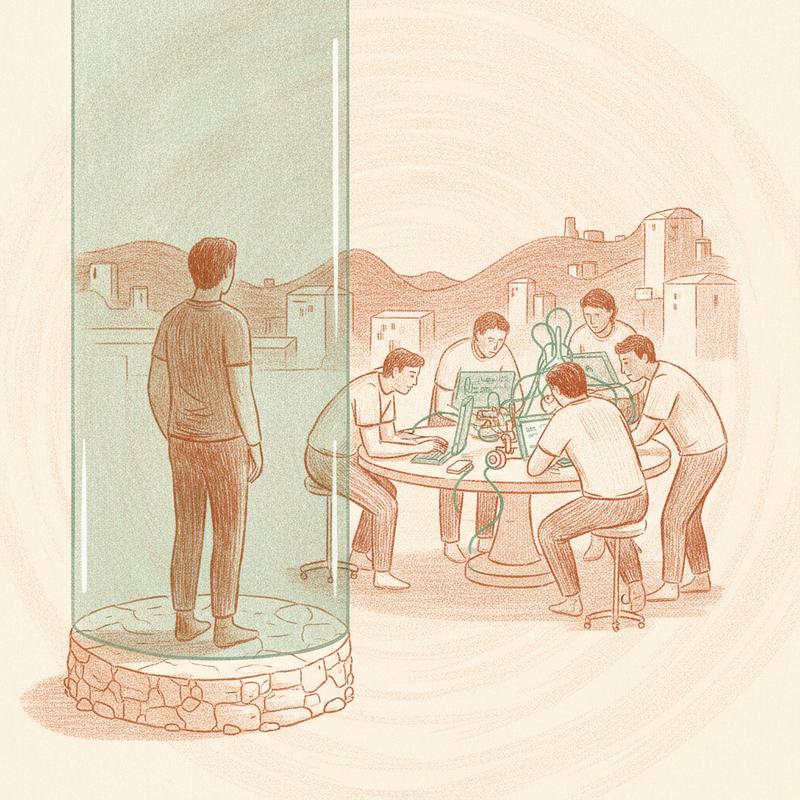
Those two numbers are the same number viewed from opposite ends. People do not withhold effort because they are lazy. They withhold effort because somewhere above them sits a person on a small raised platform behind glass, issuing decisions about work they no longer understand, and there is no percentage in caring more than the person in charge.
What Stepping Off The Platform Looks Like
Here is why Garry's line has weight rather than being a decent bit of stand-up. He built a company on the idea.
At WD-40 they do not have failures. Garry's phrase: "We don't make mistakes, we have learning moments." Say it out loud in most companies and watch the eye-rolling start. Then look at what it produced. Reported by i4cp, WD-40's engagement scores sat above 90% year after year. 98% of their people said they love telling others where they work. 99% said their opinions and values fit the place. 97% said they were clear on the company's goals.
Compare 21% engagement to 90%-plus and tell me culture is a soft topic.
Garry also said the thing most executives never admit: "Micromanagement is not scalable." A leader who has been royalized has to approve everything, because approval is the last proof of the crown. A leader who steps off the platform gives people freedom and direction, then goes and does the work only they are able to do.
He even invented an alter ego for the other path. He called it the soul-sucking CEO, and he used it to teach people exactly what to avoid. He was, by his own account, describing an earlier version of himself. Nobody arrives de-royalized. You get there by noticing.
How To Tell You Have Been Crowned
Nobody sends a memo. The signs are quiet.
- Meetings soften when you walk in. The conversation was livelier thirty seconds before you arrived.
- Nobody interrupts you any more. Everyone used to.
- You hear only good news, and you have started to find this reassuring.
- Your last unscheduled conversation with someone two levels down was months ago.
- You say "my team" far more often than "our".
- Your ideas suddenly seem better than they were before the promotion. Miraculous, is it not.
- You have begun explaining decisions instead of making them with people.
Any two of those and you are already up on the platform. The glass is the part you never notice from the inside, because from up there it looks like a window.
What To Do About It Monday
None of this is fixed by a values poster. Values on a wall are decoration. Behaviour is the operating system.
Sit somewhere else. Round tables have no head seat for a reason. If your building has a canteen, eat in it. Corporate royalty does not belong in a separate dining room.
Ask a question you do not know the answer to. Then say nothing for ten full seconds. The silence will feel like an eternity to you and like permission to them.
Say "I got this wrong" in public, with specifics. Not a humble-brag about working too hard. A real error, named, with what you learned. A team copies whatever the leader models, and a leader who never admits error trains a team who never surfaces one.
Ask to be marked. Ask the people who work for you what you should stop doing. Write it down in front of them. Then change one thing and tell them which one, so they learn the asking was real.
Watch your own deference budget. Track, for one week, how much airtime you take in meetings. Most leaders guess low by half.

The Point Of The Joke
The Queen line lands because it drags the highest status human being in Britain back into her own body. Same plumbing as the rest of us. Same three in the morning worries. Same capacity to be wrong.
Every organisational chart is a fiction we agree to for the sake of getting things done. Useful fiction. Somebody has to decide, somebody has to be accountable, and pretending otherwise gives you a committee where a decision should be. The failure is not the hierarchy. The failure is believing the hierarchy describes human worth.
Garry proved you keep the accountability and drop the royalty, and the numbers get better, not worse. Four out of five workplaces have not caught up.
So here is the question I keep asking myself, and I do not always like the answer.
If your team held a private meeting tomorrow about what it is like to work for you, and you were handed the transcript with no names attached... would you recognise the person they are describing?