Someone on your team stopped trying. You noticed about three weeks after it happened.
They still show up. Camera on. Tickets closed. Nothing to write up, nothing to praise either. The extra hour they used to give, the idea they used to bring to the Tuesday meeting, the awkward question nobody else was willing to ask... gone.
You have a name for this now. Quiet quitting.
I want to pull the phrase apart, because it does something sneaky. It puts the verb on the employee. They quit. Quietly. Bad on them. Lazy kids, no work ethic, nobody wants to work anymore.
Look at the numbers and a different story shows up.

The data points at the person running the meeting
Zenger Folkman looked at 2,801 managers rated by 13,048 of their direct reports. Under the managers ranked worst, 14% of people fell into the quiet quitting group, and only 20% were willing to give extra effort. Under the best managers, quiet quitting fell to 3% and willingness to go further hit 62%. Their write-up is here, and the title says the quiet part out loud: quiet quitting is about bad bosses, not bad employees.
Same labor market. Same generation. Same economy. Different boss. Three to four times the disengagement.
Gallup's State of the Global Workplace found global engagement dropped to 20% in 2025, down from a peak of 23%, and priced low engagement at roughly $10 trillion in lost productivity... 9% of global GDP.
Now the number worth sitting with. Manager engagement fell from 27% to 22% in a single year, the largest drop Gallup has tracked. Gallup lays most of the wider decline at the feet of disengaged managers rather than disengaged workers.
Disengagement rolls downhill. Your team caught it from someone.
A 2026 study in Frontiers in Psychology traced the mechanism with 363 employees at small and medium businesses. Authoritarian leadership drove job burnout. Burnout drove quiet quitting. And when people were pushed to work while sick, the effect got worse.
There's the chain. Boss behavior, then exhaustion, then withdrawal. Nobody in the sequence woke up one morning and chose to be lazy.
My own research says the same thing from the other end. 99.5% of the people I surveyed told me they had experienced one or more types of bad boss. Not a fifth. Not a third. Effectively everyone.
"Lazy Gen Z" is a story we tell to feel better
Blaming a generation is comfortable because it requires nothing from you. Generations arrive pre-blamed. You get to shake your head in a leadership meeting, everyone nods, and the calendar stays exactly as it was.
Here's the tell. If it were generational, disengagement would be spread evenly across every team in your building. It isn't. One team is fired up. The team two doors down is dead behind the eyes. Same age range, same pay bands, same free fruit.
The variable is not the birth year. The variable is who runs the one-on-ones.
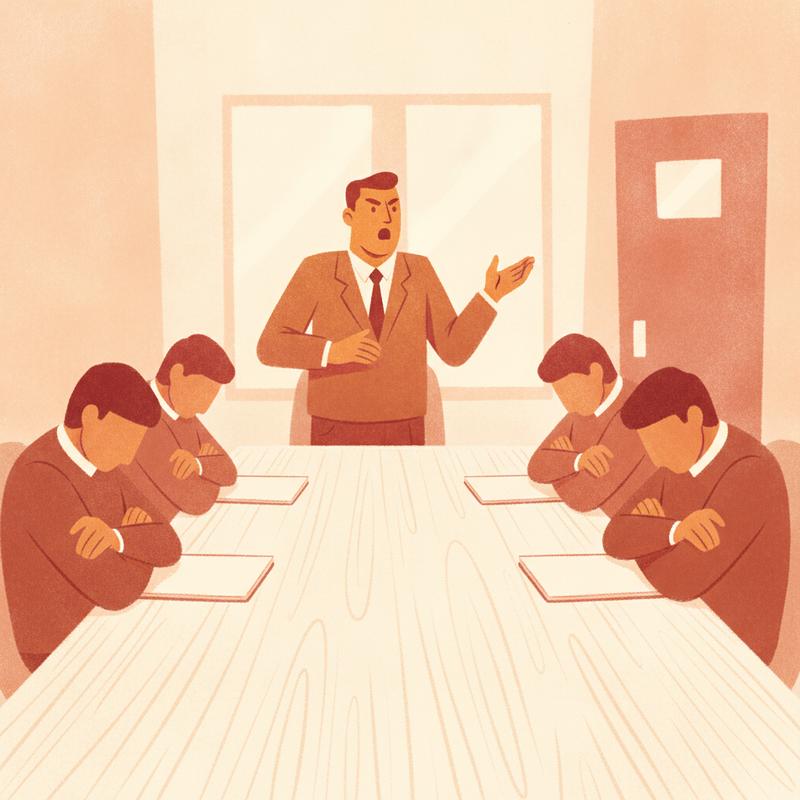
Loud leadership sounds quiet from the inside
Nobody thinks of themselves as the bad boss. Nobody. Every one of the bosses in my 99.5% had their own reasons, their own pressure from above, their own story where they were the reasonable one.
I've been the one talking. I've walked out of a meeting satisfied with how well it went, when what I'd done was fill 45 minutes with my own voice and mistake the silence for agreement. Nobody pushed back. I read it as alignment. It was surrender.
Loud leadership isn't shouting. It's volume of any kind. Volume of urgency. Volume of detail. Volume of opinion. Volume of you.
Thomas Erikson's color model is a useful lens here, because people check out in different ways for different reasons.
- The Red boss, all speed and results, exhausts the Green people who need stability. They go quiet to protect themselves.
- The Blue boss, all detail and process, grinds down the Yellow people who came for the ideas. They stop bringing ideas.
- The Green boss, all harmony, avoids the hard conversation until the Reds decide nothing matters here.
- The Yellow boss, all energy and no follow-through, teaches everyone their commitments are weather.
Four different styles. Four ways to make someone stop trying. None of them feel like bullying from where you're standing.
The check-out is not a character flaw. It's a verdict.
When someone drops to the minimum, they've run a private cost-benefit calculation and the extra effort lost. Not because effort is beneath them. Because effort stopped paying.
They tried something and got a shrug. They flagged a problem and got a process. They stayed late and nobody noticed, or worse, somebody noticed and took the credit.
Withdrawal is the rational response to a place where extra costs you something and returns nothing. Your quiet quitter isn't broken. They're keeping score, and you're losing.

Assume you go first
Here is the provocative bit, and I mean it: assume you need to change first.
Not because you're the villain. Because you're the one with the leverage. You set the meeting length, the deadline, the tone of the reply at 9pm on a Sunday. They set none of it.
Three things to do this week.
Ask the six-word question. Sit down with each person and ask: what aren't you getting from me? Then shut your mouth. The first answer is polite. The second answer is the real one, and it arrives only if you stay quiet long enough to be uncomfortable.
Change the dial, not the volume. If your instinct is to push harder on someone who has checked out, you're proving their point. A Green person needs reassurance and a clear picture of what stays the same. A Yellow person needs room and an audience. Pushing the same style harder gets you more of the result you already hate.
Fix one thing in public. Take the smallest, most fixable complaint you hear, fix it inside a week, and say out loud where it came from. Nothing rebuilds discretionary effort faster than watching feedback turn into a visible change. Nothing kills it faster than a listening session with no consequences.
If you want structure around this rather than good intentions, the awareness work we do at Step It Up HR starts in the same place: awareness first, then acceptance, then action. The order matters. Most leaders skip to action because it feels productive, and they fix the wrong thing loudly.
The part nobody wants to hear
Some of your quiet quitters are gone already. Two years of being talked over doesn't undo itself because you ran one good one-on-one. Some of them will leave, and the honest thing is to help them leave well.
The rest are watching to see whether this is a phase.
So here's my question for you. If your best person went quiet tomorrow, would you know within a week... or would you find out three weeks later, the way you did last time?