Go read my old holiday posts. They're still on this site.
Trip to Crete runs to one sentence: "Our trip to Crete was a resounding success..." followed by a link. Zip World tells you it rained in Wales. And then there's Beesands, where Deb and I stood under the Milky Way, visible to the naked eye for the first time in years. My written conclusion from this cosmic moment?
"Before our next dark-sky holiday, I'm going to get a phone with a real camera."
I went. I ate. I took pictures. I don't regret a minute of it. But read those posts and tell me what any of those places taught me about anything.
Nothing. I was a tourist, and the evidence sits on my own website.
The Anthony Bourdain of Creativity
When Debra and I had Fredrik Haren on Corey-osity Unleashed, he told us about his book, The World of Creativity. It holds 37 chapters, with 37 insights from 37 countries. Someone called it the Anthony Bourdain of creativity, and Fredrik liked the comparison enough to explain it to us.
Bourdain, he said, "wasn't about Thai food." The question was what he learned about food by going to Thailand. And under this sat a deeper one: "what did I learn about being a human by studying food in Thailand."
Fredrik works the same way. He refuses to write "people in France do creativity like this," because no country does anything one way. "Some French people eat hamburgers for God's sake."
So the country isn't his subject. The country is where he goes to test his subject.
He told us about a Thai origami artist in Bangkok who makes paper flowers. A tourist comes home from this meeting with a nice story about Thai people being relaxed. Fredrik came home with an answer to the question he carries everywhere... creative block doesn't need to come with anxiety. I wrote about it in The Beer Will Come When the Beer Will Come.
Same bar. Same beer. Different person holding the glass.
What Bourdain Did on a Plastic Stool
In 2016 Bourdain took Barack Obama to dinner in Hanoi. His own account for CNN is the best description I've read of the difference between visiting a place and paying attention to it.
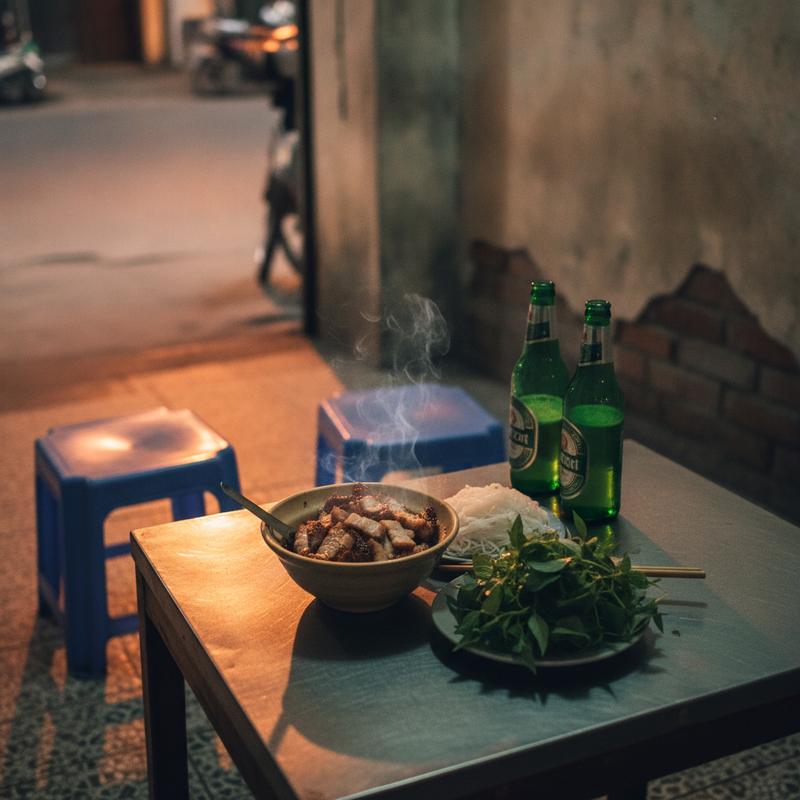
He guessed the President had spent more than his share of time in hotel banquet rooms, slogging through state dinners and "national dishes." So he picked bun cha, on the second floor of a small family-run restaurant in the Old Quarter. "Bun cha is NOT a national dish," he wrote.
The two sat on low plastic stools with Hanoi beer. Bourdain talked to him as a father. Then he watched what happened next. People on scooters pointed at him in the street, shouting "Mister Bun Cha!" A few young Vietnamese told him, with tears in their eyes, how shocked and proud they were. "It was THEIRS!" Bourdain wrote.
The way I read it, the whole evening worked as a question about people. What do you eat when nobody's watching? What does it mean when a stranger sits down and eats it with you?
Counting Places Gets You Nothing
Researchers have tested a version of this, and the results are hard on people like the 2018 version of me.
Maddux and Galinsky ran five studies in 2009. Time spent living abroad showed a positive relationship with creativity. Time spent traveling abroad did not. In one study, the degree to which people adapted to the other culture explained the link.
Adam and colleagues ran six studies with 1,874 people in 2018. Living abroad gave people a clearer sense of who they were, because it pushed them to sort which parts of their identity were theirs and which came from their upbringing. Length of time abroad mattered. Number of countries did not.
A study of 21 seasons of top fashion houses found the same shape in the commercial world. Depth of a creative director's foreign work was the most critical dimension for creative output. Breadth helped only up to a point.
And my favorite, given Fredrik's advice to marry someone from a different culture. Lu and colleagues found in 2017 the duration of past intercultural relationships predicted creativity. The number of partners did not. Collecting doesn't work there either.
Debra and I are Americans transplanted to the UK. I've felt the depth effect from the inside. A silent British meeting took me three months to read. No two-week holiday would have taught me.
I'm not sure about this part: people who choose to live abroad differ from people who stay home, and most of these samples were MBA students and online panels. Some of the experiments only prompt people to recall time abroad, and those effects are temporary. And I found no study testing whether carrying a question makes a short trip more useful. The next section is my opinion, not their finding.
Most of Us Get Two Weeks
Few of us will move countries to sharpen our thinking. So what does a two-week person do?
Carry a question. The question does part of the job adapting does. It forces you to compare what's in front of you with what you assumed.
Mathematician Gian-Carlo Rota passed along Richard Feynman's version. You "keep a dozen of your favorite problems constantly present in your mind," and test every new trick or result against them. Now and again one hits, and people call you a genius.
Looking back, I've got a lens of my own and I found it by accident. I learned to fly a paramotor for fun in 2018. Years later, those same days turned into posts about why feedback needs reps and what hope looks like on a blown-out course. Debra and I surveyed people about bad bosses, over 99% said they'd had one, and now everything I look at bends toward one question. What makes someone worth following?
If I'd had this question in Crete, the post would have run longer than one sentence.
You're a Tourist at Work Too
This goes well beyond holidays.
New managers ask what Gen Z is like, what the Germans are like, what finance is like. Fredrik would hand them a hamburger. Those questions treat people as a country you've got to summarize.
Then there's the listening tour. A senior leader visits the warehouse, shakes hands, asks how everyone's doing, gets told "fine," and flies home with a photo for the newsletter. Stamp collected.
Try the Bourdain version. Pick one question and take it to the support desk, to finance, to the warehouse. Ask each person "how do you know you've had a good day here?" Sit down while you ask. Stay long enough for the first polite answer to run out.
Now you've got something a tour never gives you. The same question, asked in five places, with five different answers to compare.
How to Carry One
- Write it down before you go. One sentence, and not about the place. "What's Lisbon like?" is a tourist question. "How do people here decide who to trust?" gets you somewhere.
- Ask someone who lives there. One long conversation beats five handshakes. Fredrik interviews one person a day, and depth is the whole point of the habit.
- Write down what changed. Do it the same day. If your notes list only what you did, you were a tourist. I've got the archive to prove how this reads.
- Swap it when it dies. A question you've stopped wondering about won't find you anything new. Go get another one.
When Fredrik asked if I'd been to Thailand, I told him no. It's on Debra's list. We'll get there, and I'd like the post from this trip to run longer than "resounding success."
So check your calendar for the next trip, the next site visit, the next conference. What question is going with you?