I have done the damage version of this more times than I like to admit.
A junior engineer pushed a change. Production went down. I walked to their desk while the incident channel was still scrolling, and I was calm about it. Reasonable. I asked good questions. And I watched their face close like a door.
They heard none of it. Not one word. I found out six weeks later in a one-to-one, when they told me the only thing they remembered from the outage was me standing behind their chair.
The itch has a name, and it belongs to you
Something breaks and you feel an urge to speak. Right now. While it is fresh, while the details are sharp, while the lesson is sitting there in the open.
Here is the uncomfortable part. The urge is yours. It serves your discomfort, not their growth. You want the situation closed because sitting inside it feels bad. Speaking ends your discomfort immediately. It starts theirs.
Sports coaches worked this out long before management did.
Roland Butcher and the moment you choose
Roland Butcher was the first Black man to play Test cricket for England. He made his Test debut in 1981 against the West Indies, in Barbados, the island where he was born. He went on to coach, and he tells the whole story in his memoir, Breaking Barriers: Barbados to England and Back.
On feedback he is blunt. Do not rush it. Choose your moment.
Debra Corey pulled five leadership lessons out of Roland's story for HRZone, and the second one lands hardest:
"If they're angry, embarrassed, or still processing the situation, your message won't land, no matter how well-intentioned it is."
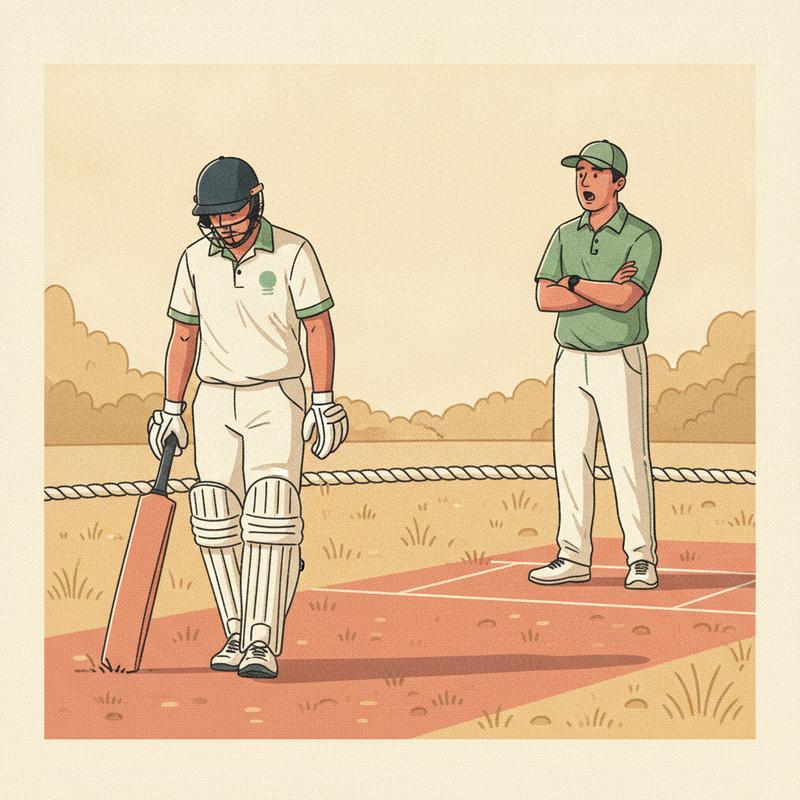
A batsman walking off after a bad dismissal is not receiving coaching. He is replaying the ball. Every coach with any mileage knows to let the man get his pads off first.
Somewhere along the way we forgot this in offices. We built an entire vocabulary around the opposite. Feedback in the moment. Real-time coaching. Radical Candor. All of it pointing one direction... sooner.
Over a third of feedback makes performance worse
I used to treat "feedback is good" as settled science. It is not.
In 1996, Avraham Kluger and Angelo DeNisi published a meta-analysis in Psychological Bulletin covering 607 effect sizes and 23,663 observations. Their finding: feedback improved performance on average, and over one third of feedback interventions decreased performance.
Read the number twice. One in three. Not neutral. Worse.
Their explanation is the useful part. Feedback moves where a person's attention sits. When attention lands on the task, people learn. When attention lands on the self, people defend. Kluger and DeNisi found effectiveness drops as attention climbs the hierarchy toward the self and away from the work.
Now picture someone who has taken production down in front of their whole team. Where is their attention already? Entirely on themselves. On their competence, their standing, whether they still belong here.
You arrive with task feedback. It gets received as a verdict on them, because self is the only channel open.
The timing did the damage. Not the words.
Why "in the moment" became gospel
The short version: immediate correction works beautifully on tight mechanical loops. Adjusting a grip. Fixing a pronunciation. Correcting a keyboard shortcut. Low stakes, no audience, no identity attached. Most of the early research on knowledge of results grew up in exactly those conditions.
Then somebody generalized it to human beings under pressure, in front of their peers, doing work tied to who they think they are. Different animal entirely.
Watch the same advice at different stakes. "Tell them straight away" is fine when a colleague has misspelled a column header. The same instinct turns corrosive when a colleague has shipped a bug to fifty thousand users.
Waiting is not going soft
I want to kill this objection early, because I hear it every single time.
Waiting is not avoidance. Waiting is not protecting feelings. Waiting is not letting the problem slide.
My own survey work on bad bosses turned up a number I still find hard to sit with. 99.5% of respondents said they had experienced one or more types of bad boss. Almost nobody escapes. And the bosses in those stories were rarely the ones who waited. They were the ones who unloaded in the moment and called it honesty.
A manager who says "I tell people things straight away, they always know where they stand" is describing a self-soothing habit dressed up as a virtue.
Delayed feedback with a hard message inside it is still a hard message. The difference is it arrives at a person capable of hearing it.
The other person who needs to cool down is you
Here is the bit nobody puts on the leadership slide.
When something breaks badly, you are not neutral either. Your quarter is affected. Your name is on the delivery. Your boss has already messaged you. You are angry, or embarrassed, or scared, and you are about to walk into a conversation carrying all three while telling yourself you are being objective.
You are not. I never was.
Give yourself the night as well. Not for them. For you. The version of me who waits until morning asks better questions, and asks fewer of the ones designed to make me feel better.
What I do instead
Three things. None of them complicated.
In the moment, work the problem, never the person. During an outage I want the site back. What do we know? What do we try next? Who needs telling? No evaluation, no tone, no raised eyebrow. Fix the thing.
Say the follow-up out loud before you leave. Something like: "Let's sit down tomorrow and pull this apart properly." Naming it kills the dread spiral. Without it, people go home and invent a far worse conversation than the one you are planning.
Give it a night, and no more than a few days. Sleep resets a surprising amount. Two weeks does not... two weeks turns the conversation into an ambush, and by then everyone else has moved on and the person wonders why you sat on it. My rule of thumb sits around 24 hours. Long enough for the heat to drop, short enough for the memory to stay sharp.
Then open on the task every time. "Walk me through what you were seeing at 4:15." Never "what went wrong with you."

The one exception
Safety. If someone is about to hurt themselves or somebody else, or torch something irreversible, you speak now and sort out the feelings afterwards.
Everything else waits.
The question worth asking yourself
Roland Butcher spent a career learning when to speak to a player and when to let him walk to the pavilion in peace. Debra and I talked to him about it on Corey-osity Unleashed, and the lesson has stuck with me longer than most.
So next time you feel the itch, ask one thing before you open your mouth.
Am I speaking now because it helps them... or because holding it for one more day feels uncomfortable to me?
Answer honestly. It will change your calendar more than any feedback framework ever has.