I have a values statement. I bet you do too. Family. Health. Curiosity. Building things worth building. The usual list.
Then last month I did something stupid. I exported my calendar to a spreadsheet and tagged every block with the value it served. Two weeks of meetings, calls, blocked focus time, all of it. Forty hours a week, tagged honestly against the things I say matter to me.
The result was ugly.
I was lying. Not on purpose. But the gap between my stated values and my actual hours was wide enough to drive a truck through.
What "Be Honest" Means Here
The phrase "be honest" sounds soft. It is not. It is the hardest instruction in leadership... harder than firing someone, harder than admitting you were wrong in a meeting.
Honest means looking at your calendar without flinching. Honest means accepting your calendar is a confession, not a plan.
Hang a poster on the wall about your values. Embroider them on a fleece. None of it matters. The only people who know what you value are the people who watch where your time goes.
Your team is watching. Your kids are watching. You should watch too.
The Two-Week Audit I Ran on Myself
Here is what I did, and you should steal it.
Step one... export everything
I pulled every calendar event from the last two weeks into a spreadsheet. Title, duration, who was on it, location.
Then I added one column: Which value did this serve?
Family. Health. Curiosity. Building. Recovery. Money work. Status work. Other.
The two new categories I added halfway through were the interesting ones. "Status work" is anything I did to look busy. "Other" is anything I did to avoid doing something harder.
Step two... add the times not on the calendar
This part hurt. The calendar lies by omission. The hour scrolling phone before bed is missing. The argument with the dishwasher is missing. The forty minutes lost to email triage is missing.
I added them. Not perfectly. But honestly enough to see the picture.
Step three... sum the columns
Health: under 4 hours. I claim health is a top value.
Curiosity: less than I thought. Most of what I labeled "learning" was news doom-scrolling pretending to be learning.
Status work: more than I want to admit.
The audit took me about ninety minutes. The insight was worth a year of leadership books.

Why Most Leaders Will Not Do This
I have suggested this exercise to a dozen leaders. Three did it. Nine did not.
The reason is simple. The audit shows you who you are, not who you tell yourself you are. The leaders who refuse are afraid of what they will find.
When I was in the US Army, we had a phrase for the gap between what someone said and what someone did. We called it "checking the boots." You wear the cleanest uniform on parade, but the boots tell the truth about whether you walked the patrol. Calendars are the boots.
I used to think the people with the busiest calendars were the most committed. Now I think the opposite. A jammed calendar is almost always a sign someone has lost control of their values and started saying yes to other people's instead.
The "Whose Calendar Am I Living" Question
Here is the question to ask after the audit:
Whose values does this calendar serve?
Sometimes the answer is yours. More often it is your boss. Or a client. Or the version of yourself you wanted to be ten years ago who is no longer running the show.
I found three hours a week of status meetings I attended only because I had attended them for years. No one would have noticed if I dropped them. I dropped them. The world did not end.
I found a recurring call I kept on the books for one person who had stopped coming six months earlier. I had been blocking off an hour every week to pretend a relationship was still alive.
I found family time. Quite a bit of it. Which was the good news. But almost all of it sat at weekends, when I was tired. Work buried the weekday hours my kids were awake and around.
What I Changed
Five things, in order of impact:
-
Killed three recurring meetings. Two with my own consent. One after a polite email saying I had been adding no value for months. Nobody fought back.
-
Blocked one hour a day called "Curiosity Hour." No agenda. No phone. Read something hard or talk to someone smart. This single block has changed more about my work than any productivity hack ever has.
-
Moved the first thirty minutes of every morning to family. No phone, no laptop. Coffee, walk, conversation. The mornings I miss this now feel wrong.
-
Set a hard stop on the day. Five o'clock. If something is so important it needs my evening, it needs to be on tomorrow's calendar in writing, not in a panic in my head.
-
Added a Friday review block. Thirty minutes. Look at next week. Ask whose values it serves. Cut what does not earn its place.
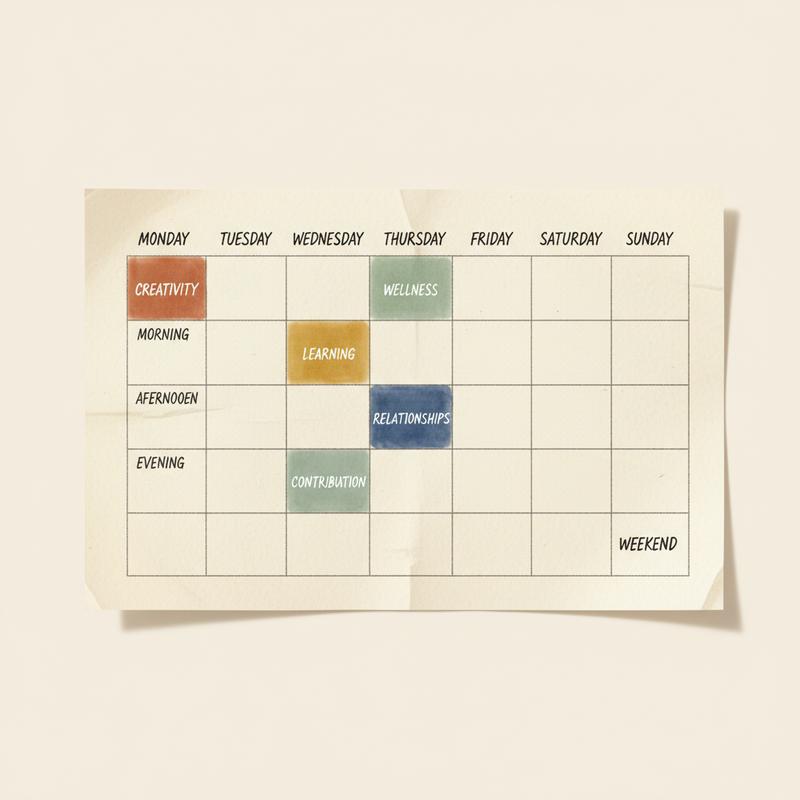
The Hardest Part Was Saying No
If you do this audit, the second half is going to be uncomfortable. You will see things you want to cut. Cutting them means saying no to people who expected a yes.
Some of those people are your boss. Some are your peers. Some are clients. Some are the part of yourself who loves being seen as helpful.
I told one team I was leaving a standing meeting. They were polite about it. Three weeks later, two of them quietly stepped out as well. The meeting now has four people instead of nine. The four who remain need to be there.
The lesson... most calendar bloat survives because nobody is brave enough to be first out the door. Be first. The others will follow.
The Weekly Ritual
The audit is a one-time event. The discipline is weekly.
Every Friday afternoon, I look at the next week. I ask three questions:
- What value does each block serve?
- Is there anything on here I would be embarrassed by if my kids asked what I did this week?
- Where is the time for the thing I keep saying matters?
It takes fifteen minutes. It saves the other ten thousand minutes of the week.
If you are too busy to do this, you are the person who needs to do this most.
A Challenge
For one week, after every meeting, write one word in your notebook... the value it served. One word. Family, health, curiosity, money, status, other.
At the end of the week, count.
You will not need me to tell you what to change. The numbers will do it.
The good news is the calendar is the easiest leadership tool to fix. You own it. You write it. You decide what goes on it. Nobody else.
The bad news is most leaders will never look at it honestly, because once you look, you have to act.
Be the one who looks. Then be the one who acts.
Your team will notice. Your family will notice. You will notice.
So... when was the last time you mapped your calendar to your values?
Be honest.