When Debra and I sat down with leadership coach Ben Morton for Corey-osity Unleashed, we spent most of the hour on AI and leadership. Near the end, I said something I still believe. If I lay people off, it isn't because ChatGPT told me. It isn't because AI told me. It's because I, as the leader of the organisation, made a decision. The responsibility is all mine.
Since then I've watched company after company do the opposite.
The new corporate alibi
Layoff announcements used to blame "market conditions" or "restructuring". Now the favourite line is AI.
In September 2025, Salesforce CEO Marc Benioff said he'd cut support from 9,000 roles to about 5,000 "because I need less heads." Plenty of other boardrooms followed with the same story.
Look at the numbers behind it, though.
Oxford Economics studied Challenger, Gray & Christmas data for the first 11 months of 2025. Companies cited AI for about 55,000 job cuts. Big number. It made up 4.5% of all reported job losses. Oxford's verdict, as Fortune reported it: firms don't appear to be replacing workers with AI on a significant scale, and some seem to be trying to dress up layoffs as good news.
Then there's New York. Since March 2025, the state has let employers tick a box on their legally required WARN layoff notices for "technological innovation or automation". Wired checked in February 2026. More than 160 companies had filed notices. Not one ticked the box. The list included Amazon and Goldman Sachs, both of whom had linked cuts to AI elsewhere.
AI drives the cuts in the press release. AI vanishes from the legal form.
Executives admit the game
You don't have to guess at the motive. A Resume.org survey of companies planning for 2026 found 59% admit they emphasise AI when explaining layoffs or hiring freezes, because it plays better with stakeholders than citing financial constraints.
Read it again. Six in ten. On the record.
Thomas Davenport and Laks Srinivasan surveyed 1,006 global executives in December 2025 for Harvard Business Review. Sixty percent had already cut headcount in anticipation of AI... 39% by a low to moderate amount, 21% by a large amount. Only 2% had made large cuts tied to AI they'd implemented.
People are losing jobs to a forecast. Not to a machine doing their work.
The Resume.org numbers point the same way. Only 9% of those companies say AI has fully replaced certain roles. Another 45% say it has partially reduced the need for new hires. And 45% say it has had little to no impact on staffing at all. Where AI touches headcount today, it mostly shows up as jobs never posted, not jobs taken away.
Even Sam Altman admits it. At the India AI Impact Summit in February, he told CNBC-TV18 some companies blame AI for layoffs they'd have made anyway. He called it "AI washing".
Why it matters who signs the letter
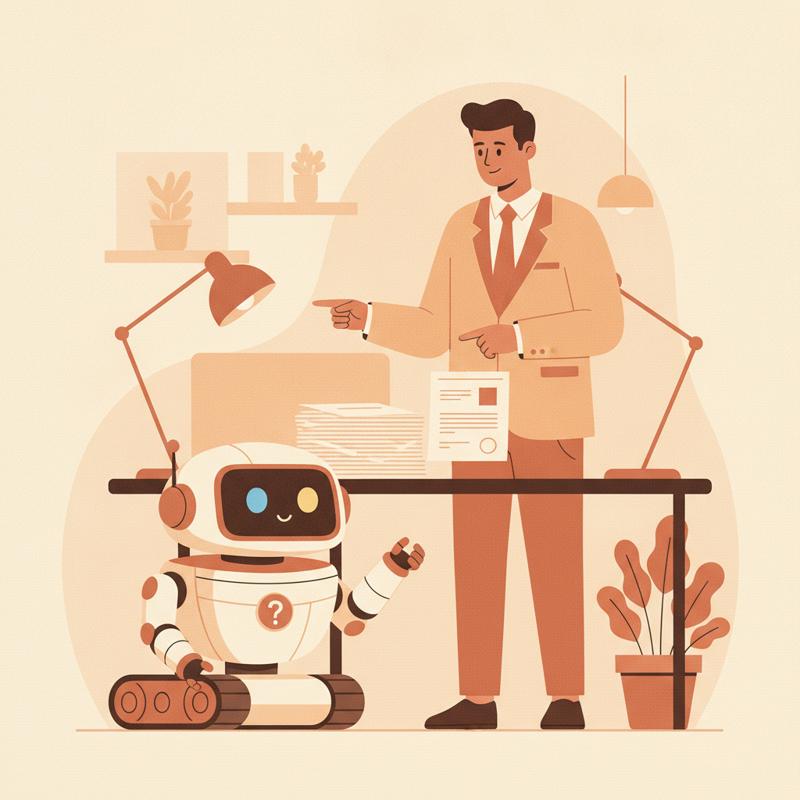
I get the appeal. AI sounds like progress. "We overhired and missed our numbers" sounds like failure. One story pleases investors. The other invites questions about the people in charge.
Your team isn't your investors.
When you blame AI, you tell the people leaving their jobs went to a machine. Some will believe you. They'll retrain for the wrong future. The people who stay hear something worse: you're next, and nobody in charge will own it.
Ben made the point on the show. He warned leaders against handing a machine any decision where the outcome lands on someone's welfare. You type into a computer program, he said, and forget the person on the other end has a family, friends and loved ones.
My own research found 99.5% of survey respondents have had one or more types of bad boss. Nobody I've spoken to describes their best boss as the one who blamed the software.
Hiding behind AI is the same failure I wrote about in Empathy Without Courage Is Cowardice. You want to look kind and modern. You skip the hard part, which is standing in front of people and owning your choice.
You're poisoning your own AI rollout
Here's the part leaders miss. Blaming AI for cuts doesn't stay in the layoff announcement. It follows the tools into every team.
You want people to experiment with AI. You want them to share what works and automate the dull parts of their jobs. Then you tell the whole company AI is the reason colleagues lost their livelihoods. What do you expect the survivors to do?
They'll hide it. They'll use AI quietly on their phones and say nothing, because showing you how much time it saves looks like volunteering for the next round. I've written before about what secret AI use says about how safe your team feels. An AI-washed layoff makes it worse overnight.
You end up with the worst of both. You took the reputational hit of "replacing people with AI", and you killed the honest experimentation you'd need to get any real gains from it.
If you made the cuts for financial reasons, say so. Your people will still be sad and angry. But they won't learn to fear the tools you need them to use.
AI informs. You decide.
I'm no AI sceptic. I use it every day, and I've argued AI should inform your decisions, not make them. The same rule applies here.
Use AI for the analysis. Model the scenarios. Ask it what you missed. Ben shared a good use on the show: before you announce a hard decision, give the tool your key points and ask what people in different parts of the business will want to know. You walk into the room better prepared.
The decision still belongs to a human. If AI ran the numbers, you chose to act on them. If a consultant recommended the cut, you signed it. If the board demanded it, you agreed to carry it out. Every path ends at a person.
What owning it looks like
If you have to cut jobs, here's the standard I hold myself to.
Say the real reason. Overhiring, a revenue miss, a change of strategy, investor pressure. Name it. People cope with hard truths far better than with spin.
Use "I", not "the model". "I decided" lands differently from "AI efficiencies require". The first is a leader. The second is a press release.
Match your words to your filings. If your legal notices say "economic", your all-hands shouldn't say "AI transformation". Your people read both, and so do journalists.
Be specific about AI's role. If AI is changing a function, say how. Which tasks. What's left. Where people move. Vague talk about "the future of work" protects you, not them.
Show up in person. Have the conversation face to face. No recorded video. No 6am email. Look the person in the eye.

The test
Here's a check before your next announcement. Read the draft out loud and swap every mention of AI for your own name. "Ken has decided these roles are no longer needed." If it makes you wince, good. The wince is the truth.
AI didn't sit in the board meeting. AI didn't approve the budget. You did.
So own it. Your people deserve the real reason, from the real person who made the call.
If you want help leading through a restructure without losing your team's trust, Step It Up HR works with leadership teams on exactly this. Ben's full conversation with Debra and me is on Corey-osity Unleashed.
So here's my question for you. Whose name belongs where your last announcement said "AI"?