I've seen it happen so many times I've started calling it "the reflex." Revenue slows. The CFO sends an email. Within 48 hours, someone has a spreadsheet open and they're hunting for line items to slash.
Training budget? Gone. Conference travel? Frozen. The online learning platform nobody remembers subscribing to? Finally cancelled.
It feels rational. Nobody bleeds when you cut L&D. No customers complain. No product breaks. The team keeps showing up on Monday. What's the harm?
The harm is enormous. And it arrives about 12 to 18 months later, when you're wondering why your best engineers are leaving, your team is falling behind on new technologies, and your competitors are shipping faster than you.
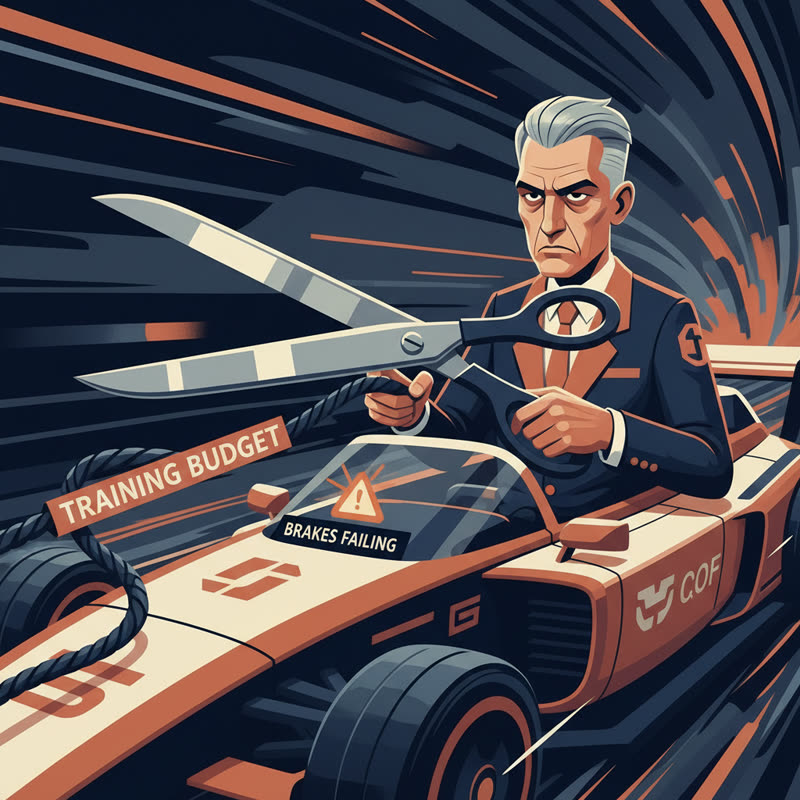
The Brake Metaphor Is Earned
Lee Woollsey put it better than I have: cutting L&D to save money is like saving money by not fixing your brakes.
You understand the metaphor immediately. The danger isn't visible until you need to stop.
When you gut training programs during a downturn, the skills gaps don't announce themselves. Your engineers don't walk into standup and say "I don't know how to do this anymore." They muddle through. They Google. They make do. And the technical debt, the outdated practices, the slow velocity... it builds up quietly until something breaks.
I've been in rooms where this decision was made and rooms where it was being reversed, three quarters later, at twice the cost. The reversal always comes: emergency hires, rushed consultants, expensive bootcamps to patch skills gaps that didn't need to exist. The budget saving evaporates, and the team's morale has taken a hit in the meantime.
What CFOs Think They're Doing
No CFO wakes up and says "I want to make my team worse at their jobs." They're doing what makes sense on a spreadsheet.
L&D spending is discretionary. It's visible. It doesn't have an obvious revenue line attached to it. You cut the conference budget and nobody's quarterly number moves. So it goes first.
Here's what the spreadsheet doesn't show: training ROI averages 353% for every dollar invested. Not 53%. Not 103%. 353%. Leadership training specifically delivers a 5.8x return in performance metrics.
These aren't feel-good numbers from a training vendor. They're industry statistics aggregated from multiple data sources. And they make the "discretionary" framing look absurd.
Few organizations bother to measure training ROI. So leadership cuts a budget item with a 353% return... because they haven't measured the return. The decision looks smart because the measurement is missing.
The 94% Number You're Ignoring
If the ROI argument doesn't move you, try this one.
94% of employees say they would stay at a company longer if it invested in their career development. Not "might stay longer." Would.
When you cut L&D during a downturn, you make a choice to accelerate attrition during the one period when stability matters most. You're telling your engineers and managers: when things get hard, you're on your own.
People hear it clearly. And they act on it.
Effective training also reduces turnover by 30-50%. So the cost of cutting your training budget isn't only a skills gap. It's an attrition event you're triggering on a delay. The talent you spent months recruiting and onboarding walks out the door 12 months later, and you're recruiting again in a tighter market.

The Income Gap
Companies with strong learning programs see 218% higher income per employee than those without.
Not 18%. 218%.
You won't see it in the budget spreadsheet. You'll see the $50,000 training line item. You won't see the compounding productivity gap opening up over the next two years as your team falls further behind companies keeping their investment in people.
The 2024 Training Industry Report tells an interesting story: total U.S. training spending fell 3.7% to $98 billion in 2024, with per-learner spending dropping from $954 to $774. The reflex, at scale, across thousands of companies. All making the same rational-looking mistake simultaneously.
What Software Teams Specifically Lose
The shelf life of technical knowledge has never been shorter.
Three years ago, the conversation was cloud-native architecture. Two years ago it was MLOps. Last year it was prompt engineering. This year it's agentic systems and AI-assisted development. Next year it'll be something I haven't heard of yet.
If your engineers aren't learning continuously, they're falling behind continuously. And in software, "falling behind" isn't a soft problem. It shows up in how fast you ship. The quality of decisions your team makes. The tools they choose. The patterns they follow.
I've watched this play out at real companies. You cut the training budget in Q2. By Q4, your engineers are fighting to keep pace with new tooling on their own time. By Q2 of the following year, your best people are quietly exploring LinkedIn, looking for companies investing in them.
Meanwhile, the companies holding the line on L&D are hiring those same engineers.
There's one more thing software teams lose: the signal. When a company cuts L&D, senior engineers read it as a sign of what's coming. People who have options start keeping them warm. The employees without options stay... but their discretionary effort, the willingness to go beyond the job description, quietly dials back.
What to Cut Instead
I'm not saying L&D is untouchable. I'm saying it should sit near the bottom of your list, not the top.
Before you touch training budgets, look at:
Redundant tooling. Most engineering teams pay for 3-4 overlapping SaaS tools doing the same job. Audit your stack. I've never done this exercise without finding money.
Meetings. Every hour of unnecessary meetings is direct productivity cost. Cutting meetings costs nothing and often speeds teams up more than any tool purchase.
Low-ROI processes. What does your team do regularly, has no one reviewed in two years, and costs people hours every week? Start there.
Contractors on maintenance work. If you're paying contract rates for work your team has capacity to absorb, look there before touching your engineers' ability to stay current.
The point isn't to protect L&D because it's nice to have. The point is to protect it because it's delivering returns your other line items probably aren't.

The Longer View
I've worked with enough engineering leaders to know why this pattern keeps repeating.
It's not stupidity. It's time horizon mismatch. The CFO thinks about this quarter. The consequences of cutting L&D arrive two or three quarters later, under different budget cycles. By then, it's hard to trace the attrition, the slower shipping, the skills gaps back to the original decision.
By then, the person who cut the training budget has moved on to the next crisis.
If you're in a leadership role facing a tough budget cycle right now, think carefully about what "saving money" means over 18 months, not six weeks.
Saving money by skipping brake maintenance doesn't save money. It moves the cost forward and multiplies it.
The same is true for your team's ability to grow.
At Step It Up HR, I work with leaders building teams built to last through exactly these kinds of pressures. If you want to talk about protecting your people's development while managing real cost constraints, you know where to find me.