On 8 September 2026, Mistral AI raised €3 billion, about $3.5 billion, in a Series D led by Samsung Electronics. The round valued the Paris company at more than €21 billion, according to The Latent. A year earlier, its Series C had put it at €11.7 billion.
Seven weeks later, Mistral opened the weights of Mistral Large 4. It is a 1-trillion-parameter model, and Mistral says it was "developed and trained from scratch in Europe". Mistral says you are free to run it on your own infrastructure "without depending on Mistral to serve it through an API."
Most people read this as a funding story. I read it as a compliance story, and a personal one. I build tools which touch people data. So before writing this, I grepped my own code to see where my prompts go.
 AI-generated illustration.
I Checked My Own Repos First
I have 15 git repos in my development folder. I searched them for the model providers they call. Here's what came back:
- Anthropic: 2 repos
- OpenAI: 3 repos
- Google Gemini: 3 repos
- A local model through Ollama: 2 repos
- Mistral: 0 repos
Every hosted model I call belongs to an American company. I never chose it on purpose. I picked whatever had the best docs the week I started each project. Then the choice set like concrete.
The illustrations on this blog come from Gemini. The drafts get help from Claude. None of it is employee data, so I sleep fine. But I suspect plenty of HR tech founders have the same default. Reach for OpenAI first. Put "Hosted in the EU" on the website. Call the privacy question closed.
"Hosted in the EU" Is One Answer to Three Questions
When a buyer asks "where does our data go?", they are asking three things at once:
- Where is it stored? The data centre's postcode.
- Who processes it? Every service the data passes through, including the model.
- Whose law reaches it? The passport of every company in the chain.
Most vendors answer the first question and stop.
The third question is the one with teeth. The US CLOUD Act lets federal law enforcement compel US-based tech companies to hand over data they hold, "regardless of whether the data are stored in the U.S. or on foreign soil". A Frankfurt data centre run by an American provider still sits under it.
The legal bridge for EU-to-US transfers is the EU-US Data Privacy Framework. The European Commission adopted it on 10 July 2023. Its two predecessors, Safe Harbor and Privacy Shield, both fell in court. In June 2026 the US Supreme Court ruled in Trump v. Slaughter on the FTC's independence. The FTC enforces part of the Framework, and privacy group NOYB said it would file a lawsuit to annul it.
I'm not sure about this part: I didn't confirm whether NOYB has filed yet, or where any challenge to the Framework stands today. Check with your own counsel before you lean on it.
Here's my point. If your product sends employee feedback to a US model API, your compliance rests on a framework with a short life expectancy. You don't control when it breaks.
 AI-generated illustration.
Why People Data Raises the Stakes
A recipe app and a feedback tool carry different risks.
Employee feedback holds names, opinions about named managers, health hints, and complaints people wrote because you promised them safety. In my research, 99.5% of survey respondents said they've had one or more types of bad boss. So most of your feedback data describes a power problem. Leak it, and the person who spoke up pays.
The EU AI Act agrees these systems deserve extra care. Annex III lists AI used "to monitor and evaluate the performance and behaviour of persons" at work as high-risk, along with recruitment and task allocation.
The deadline moved. The Digital Omnibus amendment entered into force on 27 July 2026. Under the Commission's own timeline, the Annex III high-risk rules now apply from 2 December 2027.
Some founders hear "2027" and relax. I hear "you have 12 months to rip out a model you wired in without thinking." Twelve months is not much time if the model call sits in 40 places in your codebase.
What Mistral Changes, and What It Doesn't
Mistral's pitch is sovereignty. In its September statement, quoted by The Latent, it defined sovereignty as four things: data inside your boundaries, models you control, private and predictable compute, and auditable systems.
Open weights matter here. If you run the model on hardware you rent from a European provider, no American company sits in the processing chain for the step. It answers the third question in a way no EU region badge does.
Now the caveats. I'd be a hypocrite to sell you a new default after complaining about the old one.
It's big. Large 4 has 1 trillion parameters with 52 billion active per token. Implicator wrote it is too large for a desktop or laptop, and out of reach for some universities. Self-hosting it is a real infrastructure project, not a weekend.
The route matters. Large 4 is also on OpenRouter and Microsoft Foundry. Call it through one of those and you've put an American company back in the chain. The model's passport doesn't help if the courier carries a different one.
The licence has a catch. It's the "Mistral Ecosystem Open-Weight license," a modified MIT licence. It lets you use, modify, fine-tune and sell with it. But if you run a Model-as-a-Service offering, you need a separate commercial licence. Read it before you build on it.
The benchmarks are the vendor's. Mistral reports strong coding and security scores. Implicator called the preview rankings provisional until outsiders tested the final model and weights. Test it on your own tasks.
Mistral is a company too. It took money from Samsung, BlackRock, NVIDIA, and a16z among others. A European headquarters today doesn't promise a European owner forever.
Sometimes the Right Model Is No Model
On my BAT site, the FAQ says: "BAT does not use AI to score or judge your managers. Scores come from fixed, transparent calculations."
The line saves a lot of paperwork. Fixed calculations don't need a model provider, a transfer assessment, or a high-risk conformity check. Anyone with a calculator audits them.
I'm not against AI in HR tools. I use it all day. But an LLM call added because the investor deck needed the word is a liability with no upside. If a sum does the job, use a sum.
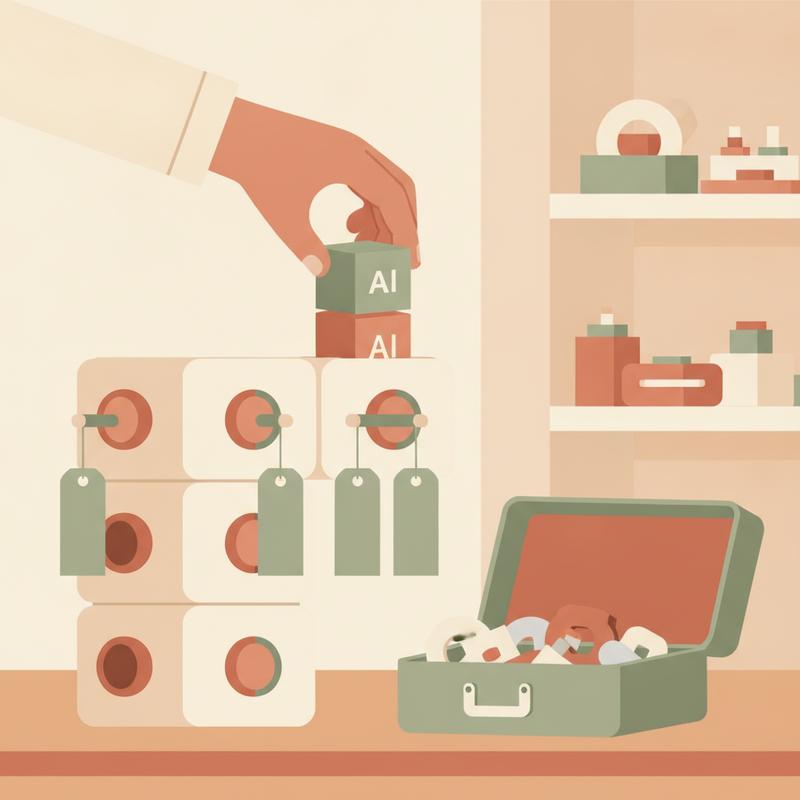 AI-generated illustration.
Four Things to Do This Month
Model choice is now a compliance decision. Treat it like one.
1. Map every prompt carrying people data
List each place your code sends text to a model. Mark the ones with names, free-text comments, or anything a person wrote about another person.
2. Write down the passport for each hop
For every model call, record three things: where it runs, which company runs it, and which country's law governs the company. Put it in a table your buyer reads in a minute. HR buyers ask this question now. Answer it before they do.
3. Make the model swappable in a day
Put every model call behind one interface in your code. Keep the prompts in config, not scattered through handlers. Then run your test suite against a second provider, a European or self-hosted one. If the Framework falls, you switch in a day instead of a quarter.
4. Ask whether the feature needs a model at all
For each AI feature touching people data, ask what a plain rule or calculation would lose. If the answer is "not much," delete the model call. You remove a risk and a cost in one commit.
Mistral's Round Is a Signal
I'm not telling you to rip out OpenAI and install Mistral tomorrow. I haven't done it myself. My count still says zero Mistral calls.
What I am telling you: Europe now has a well-funded, frontier-class model you run on your own hardware. The "there's no real alternative" excuse died on 8 September.
So here's my question. If your buyer asked you tomorrow which country's law reaches their employees' comments, would you answer in one sentence?