I used to think repeating myself meant I'd failed.
If I explained a priority clearly in the Monday meeting, I considered the job done. Saying it again felt like nagging. Saying it a third time felt like I didn't trust my team. So I said it once, said it well, and moved on.
Then Thursday came, and half the team was working on the wrong thing.
They weren't careless. My one clear sentence on Monday was competing with forty Slack threads, two incidents, a hiring loop and a customer escalation. My message didn't lose an argument. It lost a crowd.
The habit I borrowed from Sally
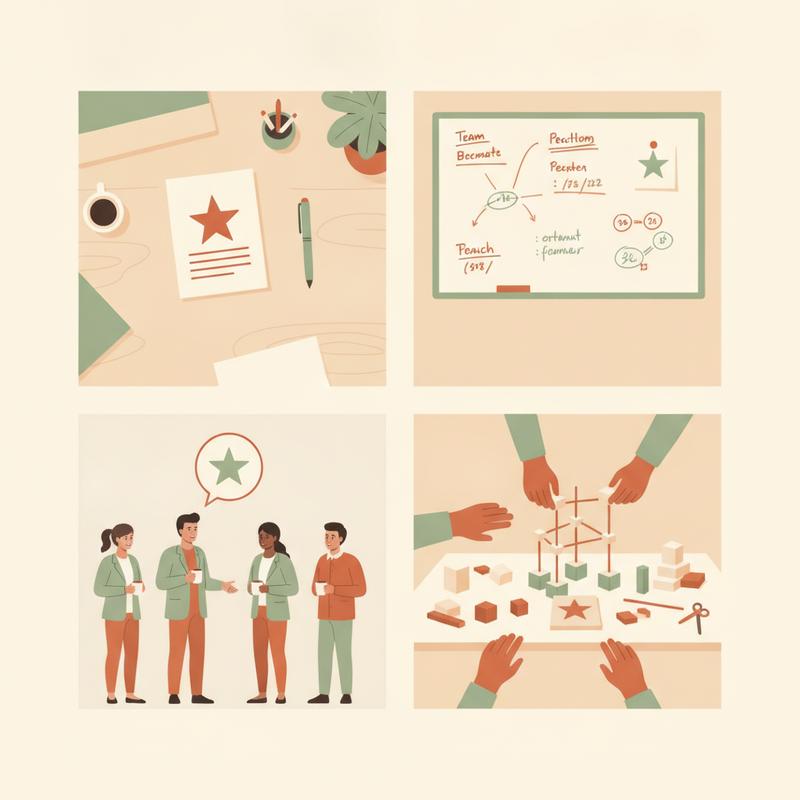
Earlier this year I sat down with Sally Gibson on Corey-osity Unleashed. Sally is Managing Director at Dawleys, and her team has won Employer of the Year. One of her habits stuck with me. She takes the same message... values, vision, expectations... and pushes it through several channels at once.
- Written, through a job scorecard each person holds.
- Spoken, in daily huddles.
- Visual, on a WOW board on the wall.
- Experiential, through a leadership project where people live the message instead of reading it.
Her reasoning: people learn and remember differently, so you repeat the message in several ways to reach everyone.
I love the practice. I want to argue with part of the reasoning, because the reason you pick shapes how well you do it.
Learning styles don't hold up
"People learn differently" usually leads straight to learning styles. Visual learners, auditory learners, kinaesthetic learners. Match the format to the person and they'll learn more.
In 2008, four cognitive psychologists... Harold Pashler, Mark McDaniel, Doug Rohrer and Robert Bjork... went looking for the evidence. Their review in Psychological Science in the Public Interest found almost no studies had used a method able to test the idea. Of the few which did, several "flatly contradict the popular meshing hypothesis." Their verdict: no adequate evidence base exists to justify learning-styles assessments in general education.
They did make one point worth keeping. The best format depends on the material. A writing course needs words. Geometry needs pictures. The content picks the format, not the person.
So if your communication plan sorts engineers into "visual" and "verbal" boxes, you're designing around a claim the research doesn't support.
Here's the twist. Sally's practice still works. It works for different reasons, and I count three.
Reason one: redundancy cuts through the noise
In 2011, Tsedal Neeley of Harvard and Paul Leonardi of Northwestern published a piece in HBR with a title I wish I'd read twenty years earlier: Effective Managers Say the Same Thing Twice (or More).
Their team shadowed 13 managers in six companies for more than 250 hours and recorded every communication the managers sent and received. One in every seven messages was completely redundant with an earlier message sent through a different technology. The managers who repeated themselves on purpose moved their projects forward faster and more smoothly.
Leonardi pushed back on the standard advice to pick the single best medium and stop there. His argument: clarity is only part of the job. The rest is making your presence felt when people report to several bosses and wade through a flood of messages every day. Redundancy keeps your issue top of mind.
I wrote before about the curse of knowledge... how a leader hears the whole song while the team hears a finger tapping on a table. Redundancy is the second half of the fix. Your team isn't failing to understand you. They're failing to notice you. Those need different cures.

Reason two: power makes you lazy about it
Neeley and Leonardi split their managers into two groups. Those with formal authority and those without.
Managers without power sent more redundant messages... 21% of their messages, against 12% for managers with power. They planned the repetition. They often started face to face to win buy-in, then followed up in writing so the commitment stayed on the radar.
Managers with power assumed one instruction was enough. They tended to start with an email or a voicemail and only followed up when nothing happened. Neeley said those managers got as much done but took longer, and spent more time on damage control. Leonardi added a fair caveat: they had no data showing either group beat the other on deadlines or budgets. Employees did hold the managers without power in higher esteem.
This one stings. The more authority you hold, the more likely you are to say it once and expect it to stick. I've done it. Every new title made me a little worse at it.
If you lead in tech, your engineers also hear from product, from sales, from on-call, from their skip-level. Your rank doesn't make your message louder. It makes you assume it is.
Reason three: spacing beats cramming
The third reason is about memory.
Psychologists have studied the spacing effect for more than a century. In 2006, Nicholas Cepeda and colleagues pulled together 839 assessments from 317 experiments on distributed practice. Spaced learning beats one big dose for retention, and the longer you need people to remember something, the wider the gaps between repetitions should be.
An all-hands with the strategy deck is cramming. One big dose, then silence until next quarter. The scorecard on Monday, the huddle on Wednesday, the board on the wall all week and the project next month... now you have spaced practice. Sally's system gets this right by design.
How I'd run it on an engineering team
Here's what I'd do on Monday morning.
Pick one message. One. Try to repeat five and nobody hears any of them. Write it as a sentence a new starter would repeat back word for word.
Say it face to face first. Use the conversation for the why. Take questions. Watch faces. Buy-in happens here, and Neeley and Leonardi's managers without power led with it for a reason.
Follow up in writing the same day. A short post in the team channel or an email. Same words. This is the receipt. It gives people something to point to when the next escalation tries to pull them off course.
Put it where people look. A pinned message, the top of the sprint board, the first line of the team README. Not a poster in the kitchen. Wherever your team's eyes land ten times a day.
Make them use it. Ask each engineer to name one decision this week where the message changed what they did. Bring those stories to the retro. People remember a message they've acted on far longer than one they've read.
Space it out. Bring it back in the next one-to-one, the next planning session, the next incident review. Not daily. Often enough to stay ahead of the forgetting.
I covered the questions every engineer carries around in Your Team Has Five Questions. "What's expected of me?" is one of them. This is how you keep answering it after the first time.
The objection you're about to raise
"Won't my team find this annoying?"
Leonardi wondered the same thing. He asked whether a redundancy threshold exists, a point where people say "enough." The study didn't answer it.
Here's my rule of thumb. Repetition annoys people when each pass does the same job as the last one. Repetition helps when each pass does a different job. The conversation motivates. The written note documents. The board reminds. The project makes it real. Four channels, four jobs, one message.
And if you're worried about nagging, ask your team. "Am I repeating this too much?" If they say yes, good... it landed. If they look puzzled, you haven't said it enough.
Say it again
Next time you catch yourself thinking "I already told them," stop. You told them once, in one channel, on one day. They heard it somewhere between a deploy and a dentist appointment.
Say it again. Say it somewhere else. Then check whether anyone acted on it.
What's the one message your team needs to hear four ways this month?