Every week I talk to someone whose AI agent rollout stalled. They bought the right tools, got the vendor demos, ran a proof of concept. Then nothing happened.
They blame the technology.
They are wrong.
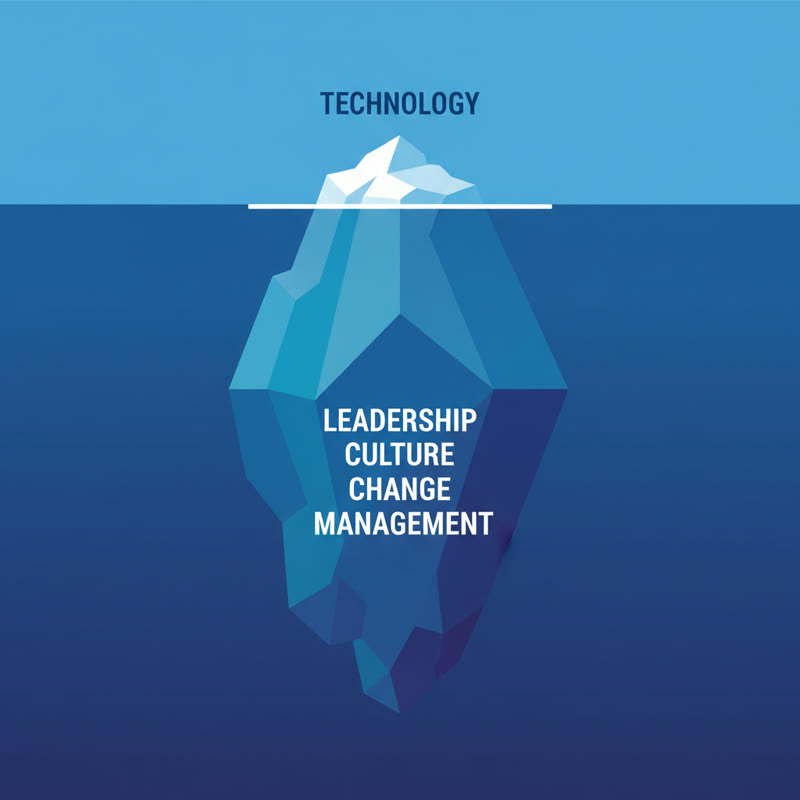
Anthropic's 2026 State of AI Agents Report lists the top three blockers to AI agent adoption: integration challenges (46%), data quality (42%), and change management (39%). Change management sits at number three on the list. I'd argue it's number one, because integration failures and data quality problems are symptoms of organizational dysfunction far more often than they are technical limits.
The technology is not the bottleneck. Your leadership is.

The Numbers Are Ugly
95% of generative AI pilots are failing. Fortune magazine ran the number. Companies are spending money, time, and political capital on AI initiatives... and nine out of ten are coming back empty-handed.
Deloitte's 2026 State of AI in the Enterprise report shows 74% of organizations hope to grow revenue through AI. Only 20% are doing it. One in three organizations is "deeply transforming" with AI. The rest are running surface-level experiments and calling it a strategy.
McKinsey's 2025 Global AI Survey found 23% of organizations are scaling AI agents in production. Another 39% are still experimenting. The gap between experimenting and scaling isn't a mystery. It's a leadership gap dressed up as a technical one.
The METR Paradox
Here is the strangest data point I've read this year.
METR ran a study on AI productivity with experienced open-source developers. They gave developers AI tools and asked them to estimate how much faster they were working. The developers said 24% faster. After the study concluded, they still believed they were 20% faster.
The measured result? They were 19% slower.
Developers felt faster. They were slower. They worked harder and produced less.
This is not a knock on developers. It points to something important: when organizations roll out AI tools without changing the surrounding systems, habits, and expectations, the technology creates new overhead instead of removing old friction. The tool becomes another thing to manage. It adds cognitive load without removing any of the original work.
Leaders see the demos, run the pilots, and declare the technology ready. But the organization around it is unchanged. Same workflows. Same expectations. Same performance metrics. You cannot drop a new capability into an old system and expect the old system to adapt on its own.
Why the Tech Conversation Is a Trap
The default conversation about AI is a product conversation. Which model? Which platform? Which vendor? How many parameters? What's the context window?
None of it matters if your organization is not ready to change how it works.
The Stanford Enterprise AI Playbook is clear on this: "The failures share a pattern: teams treated AI as a technology project instead of a process and change management project. First attempts failed when applied to broken workflows, when led by technical teams without business ownership, or when organizations assumed the model would fix problems requiring redesigned work itself."
Read it again. Broken workflows. No business ownership. Assuming the model will fix a process problem.
These are not technology failures. They are leadership failures.
What Leaders Get Wrong
I've watched this play out enough times to see the pattern clearly.
They lead with the tool, not the workflow. "We're deploying Copilot company-wide" is not an AI strategy. Which workflows change? Who owns the outcomes? How do you measure whether it worked? Without answers to those questions, you have a tool with no home and no accountability.
They skip the psychological safety conversation. Employees who worry AI will expose their weaknesses or eventually take their jobs will route around it. They will submit AI output for review without editing it. They will report they are "using AI" while quietly not trusting it. You will get bad outputs and blame the model when the real problem is the culture preventing honest feedback.
They measure inputs instead of outcomes. Counting licenses bought or training completions tells you nothing useful. What changed?? Where did time go? What did teams stop doing so they were free to do something better? Without outcome metrics, you are flying blind and will not know whether the rollout worked until it is too late to fix it.
They appoint a tech lead instead of a change lead. AI rollouts succeed when someone in the room is thinking about adoption, not architecture. Your best engineers are not automatically your best change agents. They skip straight to implementation and forget most of their colleagues are still figuring out the basics.
They declare victory after the pilot. A pilot proves the technology works in one context. It tells you almost nothing about whether it will work at scale across your organization. The hard part starts after the pilot.
The 57% Signal
Mid-2026 enterprise data shows 57% of executives now expect people to manage and direct AI agents, not be replaced by them. Good framing. But expecting employees to manage AI agents while failing to redesign roles, expectations, and workflows around the new responsibility is the same error wearing a different coat.
Deloitte shows 53% of organizations are investing in educating the workforce and 48% are designing upskilling strategies. Far fewer are redesigning roles, career paths, or workflows. They are teaching people about the tools without changing the environment the tools live in. It is like teaching your team to drive while leaving all the roads exactly the same.

What the Companies Getting It Right Do Differently
They treat AI adoption as an organizational design question, not a software rollout. The question is not "which tool should we use?" It is "what does work look like when AI handles the execution layer?"
They talk openly about fear. Not in a soft, hand-holdy way... but directly. Here is what is changing. Here is what we expect from you. Here is how we are measuring this. Here is what your role looks like going forward. Ambiguity is where resistance lives. Clarity is the antidote.
They run small experiments with explicit feedback loops. Instead of a company-wide rollout, they pick one workflow, run it with AI, measure the before and after honestly, and share what they learned... including what failed.
They give people permission to report bad experiences. If no one is allowed to say the tool is not helping, you will only hear the good ones. Then you will spend money scaling something working for ten people and failing for ninety.
They redesign the work, not the tools. The key question is not "how does AI fit into what we do?" but "what would we do differently if AI were already doing the execution work?"
The Real Question
AI agents are ready. The models are fast, the integrations are mature, and the use cases are proven. You do not need better technology to start seeing results from AI agents.
You need leaders willing to redesign how work gets done, have the uncomfortable conversations about what changes, and measure outcomes instead of activity.
The 39% of enterprises citing change management as a top barrier are not struggling because the technology is hard. They are struggling because changing human systems is hard. It requires a different kind of leadership than shipping software does.
Most organizations are not short on AI tools. They are short on leaders willing to do the organizational work.
What would need to change in your organization for AI agents to stop being experiments and start being infrastructure?