Last week a single first down lit up Reddit.
Miami's Chop Robinson hit Patrick Mahomes on third-and-9, the referee threw a roughing-the-passer flag, and Kansas City kept the drive alive. The thread on r/sportsgossips pulled in over 2,800 comments. Thousands of people argued about one set of downs in one game. Nobody was arguing about a touchdown. They were arguing about ten yards.
I'm American. I grew up with this game. And the more I think about it, the more I believe American football got something right about progress, something most of us ignore in our work and in our lives.
Football Built the Small Win Into the Rules
Here's how the game works, for anyone who didn't grow up with it. The offense gets four plays to move the ball ten yards. Make the ten yards, and you earn a fresh set of four. Miss it, and the ball goes to the other team. Wikipedia's American football page covers the basics.
Look at what this does. A touchdown sits 80 yards away. Nobody in the huddle talks about 80 yards. They talk about the next ten.
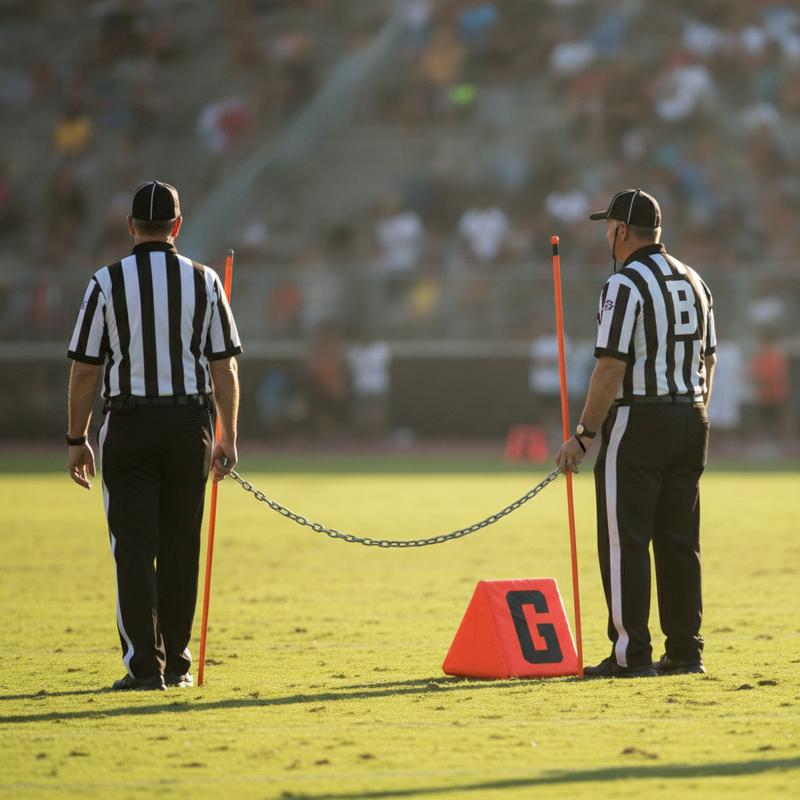
And the game doesn't leave the ten yards to a vibe or a guess. There's a whole crew whose job is measuring it. According to Football Zebras, the chain crew has seven people: two holding the stakes, one on the down box, one on the marking clip, and a few more. Seven adults, at every professional game, whose whole job is to mark a small win and reset the target.
When the offense makes it, the officials signal it, the chains move, and the crowd cheers. The stadium celebrates a first down. Out loud. Every time.
When did your team last cheer for ten yards?
Touchdowns and First Downs
I came across this idea through James Ferguson, a culture coach and the author of The Confetti Culture Playbook. He was a guest on my podcast, Corey-osity Unleashed, and his advice lands hard for anyone who leads people. In an interview with The Tilt, he tells people to celebrate every step of the way... the first downs as well as the touchdowns.
He also said this: "It's all about self-talk and celebrating small wins."
Self-talk. I want to come back to this, because I think it's where most of us go wrong. We don't skip celebrating other people's first downs because we're mean. We skip them because we never celebrate our own.
My Two Weeks Counting Only Touchdowns
In October 2018 I flew to Malaga to learn to fly a paramotor. A paramotor is a big fan strapped to your back with a paraglider wing over your head. I had one goal: get into the air and fly.
It wasn't my first try. A course in England in August 2018 had washed out. My first day of training there was theory, meteorology, and rain.
In Spain, we started small. On my first full day we went kiting for the first time, launching a half-size wing on the beach and learning to control it in gusty wind. My arms shook for hours afterward.

A few days later we strapped the engines on our backs, ran them up to about 25% power, and practiced walking with the thrust trying to push us onto our faces. Then forward launches. Then raising the wing with the motor on my back, which I described at the time as excruciating.
On 22 October, I made it into the air. The instructor started yelling "full power, full power" and the next thing I knew, I was 50 feet up and climbing.
Touchdown, right?
Here's the thing. I don't remember celebrating it much. The next morning I had a gorgeous flight, then two face plants in a row and a broken propeller tip. Another day, I put the motor on my back three separate times and never took off. I wrote at the time about feeling the days slip past. I signed off the post frustrated.
I read those posts again this week. What jumps out at me now isn't the frustration. It's the progress. Kiting. Engine on. Forward launch. Into the air. Formation flying behind another pilot. Every one of those was a first down. I logged them in a blog every night, and I still didn't count them, because I had my eyes fixed on the end zone.
If I treated my own training this way, I promise you I've treated people on my teams this way too.
What the Research Says About Ten Yards
I wanted to know if the first-down idea holds up outside a stadium. It does.
Close goals beat far goals
In 1981, Albert Bandura and Dale Schunk at Stanford ran a study with 40 children who struggled with arithmetic and had little interest in it. All the children worked through the same 42 pages of subtraction problems over seven sessions. The researchers suggested one group aim for at least six pages per session. Another group got the goal of finishing all 42 pages by the end. A third group got no goal at all.
The six-pages-a-session group pulled ahead. In the authors' words, those children "progressed rapidly in self-directed learning, achieved substantial mastery," and developed real interest in arithmetic. The far goal? "Distal goals had no demonstrable effects." Read the full paper in the Journal of Personality and Social Psychology.
Same work. Same total. The only difference was where the chains sat.
Seeing progress speeds you up
In 2006, Ran Kivetz, Oleg Urminsky, and Yuhuang Zheng studied a coffee shop reward card at Columbia University. Customers bought coffee more often the closer they got to a free one. And when the café handed out a 12-stamp card with two "bonus" stamps already filled in, people finished the ten purchases they needed faster than people holding a plain ten-stamp card. The study ran in the Journal of Marketing Research.
Same ten coffees. People moved faster when they saw progress already on the card.
I wrote about Teresa Amabile's research on small wins in a post on glimmers in hard times, so I won't repeat it here. The short version: progress on meaningful work drives good days. The two studies above add the next piece. People need to see the progress, and the target needs to sit close.
How I Mark First Downs Now
I'm not good at this yet. Here's what I'm working on, at work and at home.
Name the ten yards before the drive starts
A first down only counts if everyone knows where the line sits. Before a project starts, I ask: what's the first thing we'll finish in the next week or two? Not the launch. The thing before the thing before the launch. Write it down.
Say it out loud when it happens
The stadium doesn't wait for the touchdown to cheer. When someone moves the chains, I tell them, the same day, in front of the people who matter to them. Ferguson's whole book is about this, and so is my work at Step It Up HR. People don't need a party. They need someone to notice.
Put it somewhere you'll see it
The coffee card works because the stamps sit in your wallet staring at you. Progress you don't see doesn't motivate you. A ticked list on a wall, a column on a board, a line in a weekly note. Pick one and keep it in plain sight.

Don't move the chains backward after a bad play
My face plants didn't undo my first flight. A fumble doesn't erase the yards you gained on the drive before it. When a project hits a setback, I try hard not to talk as if the team is back at the start. They're not. Say so.
Start with yourself
This is the part Ferguson nailed. If you don't count your own first downs, you'll walk straight past everyone else's. Tonight, write down three things you moved forward this week. Small ones. Ten-yard ones.
The Chains Are Already Moving
Most of life happens between the end zones. If you only celebrate touchdowns, you'll spend almost all your time in silence, and so will the people around you.
So here's my question for you. What did someone on your team, or in your house, gain this week... and have you told them yet?