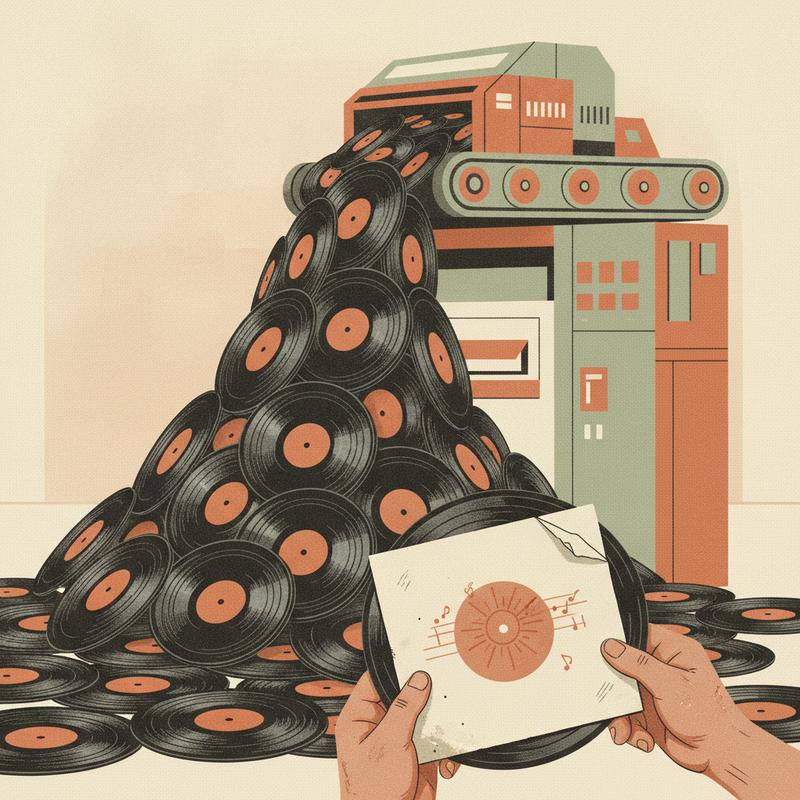
On Tuesday, Tidal said it will start deleting fully AI-generated music on 9 December. By the end of the year, more than 29 million songs will be gone from the platform.
I read the story twice. Then I thought about the last employee survey I looked at.
Here's why the two belong in the same post.
 AI-generated illustration.
What Tidal Saw
The numbers in TechCrunch's report are worth sitting with.
- 27 million tracks on Tidal are fully AI-generated. Those make up 6.3% of the catalogue.
- 96% of those tracks have zero streams. Not low. Zero.
- Over the past 90 days, more than 43% of uploads were AI-generated.
- Under the new rules, Tidal expects to reject 80,000 to 85,000 tracks a day.
Tidal's lead, Robert Anderson, put it plainly on X: "43% of tracks distributed to us in the last 90 days have been detected as AI-generated."
The company's own statement names the real cost. At this scale, it said, the authentic music and artists its subscribers want to hear "get buried."
Buried. Nobody streams the junk. It still costs the real artists their place in the queue.
Tidal isn't alone in seeing this. Deezer reported in July its uploads crossed 50% fully AI-generated at peak in June. Close to 90,000 AI tracks a day. Those tracks pull 1 to 3% of streams. And Deezer found up to 85% of the streams on fully AI tracks in 2025 were fraudulent.
So the pattern looks like this. Volume explodes. Attention doesn't follow. Fraud fills the gap.
Tidal still accepts music made with AI assistance. The ban hits tracks made entirely by a machine. I think the line sits in the right place.
The Part Which Should Worry You
Deezer also ran an Ipsos survey of 9,000 people across eight countries. In a blind test, 97% were unable to tell fully AI-generated music from human music.
Ninety-seven percent.
Now swap "music" for "comments in your engagement survey."
When you read the free-text answers in your next pulse survey, how sure are you a person wrote each one? And if a person did, how sure are you the words came from them and not from a chatbot they asked to "make this sound professional"?
I'm not sure about this part: I looked for hard data on how many employee survey comments are written or polished by AI today, and I found none worth quoting. Nobody seems to be measuring it inside companies yet.
The research world is measuring it, and the results aren't comforting.
 AI-generated illustration.
The Research Already Rang the Bell
Back in 2023, a research team reran a summarisation task on Amazon Mechanical Turk. Using keystroke tracking and text classifiers, they estimated 33 to 46% of the crowd workers used large language models to do the work. People paid to provide human answers handed the job to a machine.
Then in November 2025, Sean Westwood at Dartmouth published a paper in PNAS with a title nobody in HR should skip: The potential existential threat of large language models to online survey research.
He built a synthetic respondent. It held a consistent persona. It remembered its earlier answers. It wrote open-text replies pitched to the education level of the person it pretended to be. It passed standard attention checks 99.8% of the time across 6,000 trials.
His core line stuck with me: the assumption "a coherent response is a human response" no longer holds.
Read the sentence again with your annual engagement survey in mind. Every HR dashboard I've ever seen treats a coherent comment as a person's honest view. The assumption is breaking.
Why This Hits Feedback Harder Than Music
A fake song wastes a listener's three minutes. A fake comment changes a decision.
Think about who reaches for AI when writing feedback.
- The person scared to say the real thing. They ask a chatbot to soften it. The edge you needed to hear gets sanded off.
- The person who doesn't care. They paste in something polished and generic to tick the box.
- The person who wants to sound senior. Their frustration comes out as tidy management speak.
In every case, the words arrive cleaner and say less. You end up with the employee survey version of Tidal's 27 million tracks. Lots of volume. Almost no signal.
This matters to me because of what the signal is for. My own research found 99.5% of people have had one or more types of bad boss. Most of those bosses never found out. Feedback is the only route the truth has to travel up. If the route fills with polished filler, the bad bosses stay invisible for longer. I wrote more about the patterns over at Step It Up HR.
The Authenticity Premium
Here's the upside. When generation costs nothing, genuine human signal becomes the scarce thing. Scarce things gain value.
Tidal is betting its subscribers will pay for a catalogue where a person made the music. I think the same bet works inside a company. The leader who gets real, rough, unpolished truth from their team holds an edge over the leader drowning in tidy survey prose.
So how do you get it?
Ask for specifics, not opinions
"How do you feel about communication on the team?" invites a chatbot answer. "What happened in Tuesday's planning meeting which stopped you speaking up?" doesn't. A machine has no idea what happened on Tuesday. Your team member does.
Stop rewarding polish
If people learn the well-written comments get taken seriously, they'll reach for the tool which writes well. Thank people for the blunt one-liner with a typo in it. Act on it. Say out loud you acted on it.
Make the survey smaller
Long surveys breed autopilot. Three questions answered honestly beat thirty answered by a bot. My BAT framework leans on short, frequent check-ins for this reason.
Treat the survey as a prompt for a conversation
The survey tells you where to look. The conversation tells you what's there. No AI sits between you and a person on a bench with a cup of tea.
 AI-generated illustration.
Where I Stand on My Own Use
I'd be a hypocrite to write this without saying where I draw the line myself.
I use AI to make the illustrations on this blog. Every one carries a caption saying so. I made the commitment publicly earlier this week, and this post follows it. You know what you're looking at.
I think the same rule belongs in feedback. AI help isn't the enemy. Hidden AI help is. Tidal didn't ban AI-assisted music. It banned the stuff pretending a person made it, the stuff flooding the shelves until the real work got lost.
If your team uses AI to tidy their survey comments, I'd rather they told you. "I used ChatGPT to soften this because I was nervous" is itself a piece of honest feedback. It tells you something about safety on your team you won't get from the comment itself.
What I'd Do This Week
Pull up the free-text answers from your last survey. Read ten of them out loud.
Count how many sound like a real person you know. Count how many sound like a press release.
If the second number is bigger than the first, you don't have a survey problem. You have a trust problem, and no detection tool will fix it for you.
Tidal needed to delete 29 million songs to give real artists room to be heard. What would you need to clear out to hear your own team?