When I was 18 years old, I joined the US Army. Nobody handed me a 10-year plan. Nobody told me where I'd be at 30, or 40, or 50. I was too busy learning how to stay alive, lead people under pressure, and adapt when everything went sideways.
Not because military structure prepared me for corporate life ... it didn't. The Army stripped away the illusion of control and replaced it with something more useful: the ability to figure things out under pressure, with whatever resources you have.
After the Army, I moved into tech. Not because it was "the plan" ... because it was the next thing making sense. From there, I led teams. Built products. Managed engineers through crises they thought were unique to tech, which were the same leadership problems every organization faces. Wrote a book. Started companies. Built tools to help leaders be less terrible to their teams.
If you drew my career on paper, it would look nothing like a ladder. It would look like someone dropped a plate of spaghetti.
Fine. More than fine.
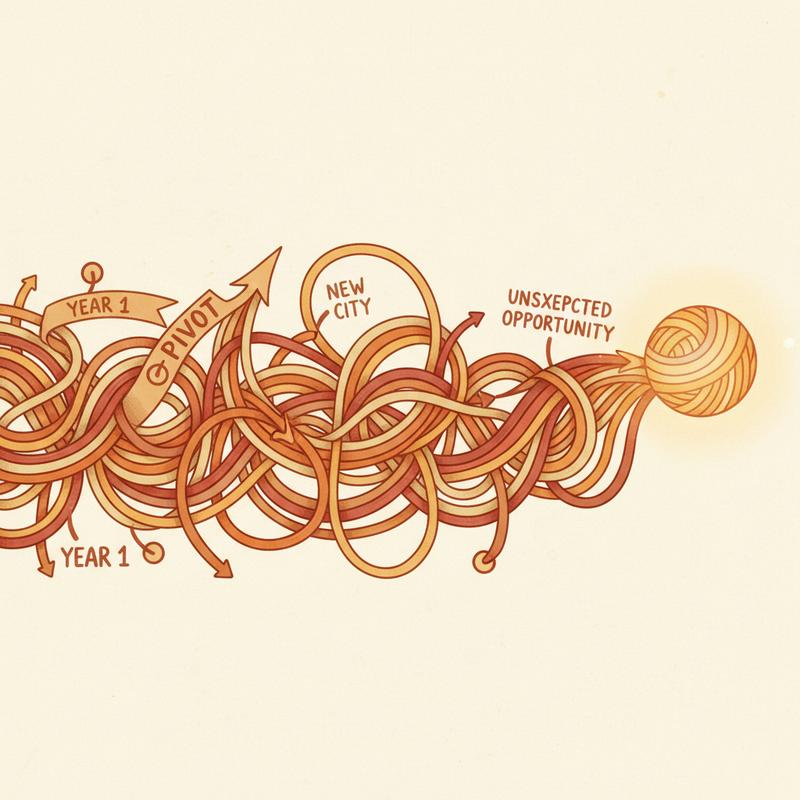
The Ladder Is a Lie
We bought into a fantasy. Go to school, pick a path, climb steadily upward. Add the right titles. Hit the right checkboxes. Retire at the top.
It was never real for most people, and it's even less real now.
According to a recent survey, 61% of workers want to switch careers. More than half of UK employees have already made one major career change. Generation Z workers will likely hold 16-17 jobs over 5-7 years.
The ladder model doesn't fit these lives. It never did.
And yet people still feel guilty about it. They apologize for the "gaps" on their resume. They downplay the pivot from sales to software, or from military service to management. They treat their non-linear path as a liability when it's anything but.
What the Army Taught Me About Careers
The Army doesn't do career plans. It does mission objectives.
You get a mission. You figure out how to accomplish it with what you have. You adapt when the situation changes, because the situation always changes. You lead people through uncertainty, not toward a predetermined destination. And when the mission shifts, you don't mourn the old plan ... you pick up the new one.
The mindset didn't fit neatly into civilian corporate culture when I first crossed over. Hiring managers wanted to see a straight line. They wanted to know where I saw myself in five years. The Army had taught me to care about the mission and the people, not career positioning. Nobody in my unit asked what my five-year plan was. They asked what I was going to do today to make the team better.
So I learned to translate. To take those leadership instincts and package them in language hiring managers recognized. And somewhere in the translation, I realized the spaghetti wasn't a problem. It was the product.
Every deployment, every assignment, every lateral move the Army put me through had given me something the straight-path candidates sitting across the table from me didn't have: proof I'd done hard things in conditions I didn't choose.

The Spaghetti Advantage
Here's what a non-linear career gives you:
Pattern recognition across domains. When you've worked in multiple fields, you see connections other people miss. You notice the leadership problem you're solving in a tech company is the same one you saw in a logistics unit fifteen years ago. This cross-domain vision is rare. Most people inside one industry for twenty years see the trees. You see the forest. And when you see the forest, you ask better questions, spot the patterns earlier, and avoid the mistakes everyone else keeps repeating.
Resilience. People who've only ever walked a straight path struggle when it bends. People who've navigated three or four major pivots know disruption isn't the end of the story. It's usually the beginning of a better one. You've already proved it to yourself.
A wider identity. If your entire identity is tied to one job title or one industry, you're fragile. A title change feels like an identity crisis. Spaghetti people have a stronger sense of who they are underneath the resume, because they've had to build it.
Adaptability. The modern job market rewards it. Over 70% of companies now use skills-based hiring rather than hiring for experience alone. Your ability to learn and apply matters more than a clean resume narrative.
How to Tell the Spaghetti Story
Here's what people with non-linear careers get wrong: they apologize for the story instead of telling it.
"I know my background is a bit all over the place..." is a terrible way to introduce yourself. It signals shame before anyone asked for it.
The spaghetti career becomes a problem when you can't explain the thread running through it. Not a ladder, not a straight line ... a thread. A set of values or skills or obsessions you've carried from one thing to the next.
For me, the thread is leadership. Every role I've had, every company I've built, every book I've written comes back to the same question: how do you get a group of people to do hard things together without making them miserable? The thread runs from my first platoon to my latest startup.
Find your thread. Once you have it, the spaghetti stops looking like chaos and starts looking like a career with depth.
The Real Cost of the 10-Year Plan
The plan isn't neutral. It has a cost.
When you're committed to a plan, you say no to anything not fitting it. You turn down the unexpected opportunity because it's "off track." You stay in a role making you miserable because leaving would mean admitting the plan failed.
Only 46% of workers feel supported in their career development, according to a 2023 Gartner survey. Part of the reason is people are trying to shoehorn their actual working lives into a framework not built for them.
The plan becomes a cage.
What I'd Tell Myself at 18
I wouldn't tell myself to plan better. I'd tell myself to stay curious, say yes more often, and stop treating detours as failures.
Every "wrong turn" in my career taught me something the straight path wouldn't have. The Army gave me leadership skills no MBA program teaches. The tech work gave me systems thinking. The writing and speaking gave me a way to share what I'd learned. Each piece fed the next.
Ruth Wooderson puts it this way: screw the 10-year plan. Careers aren't ladders, they're spaghetti. I've stolen the framing completely, because it's the most honest description I've ever heard.
Your Turn
If your career looks messy right now, good. It means you've been paying attention to life instead of a spreadsheet.
The question isn't "does this fit my plan?" The question is: does this make you better at something worth caring about?
Follow the curiosity. Take the pivot. Tell the true story.
The spaghetti is the point.